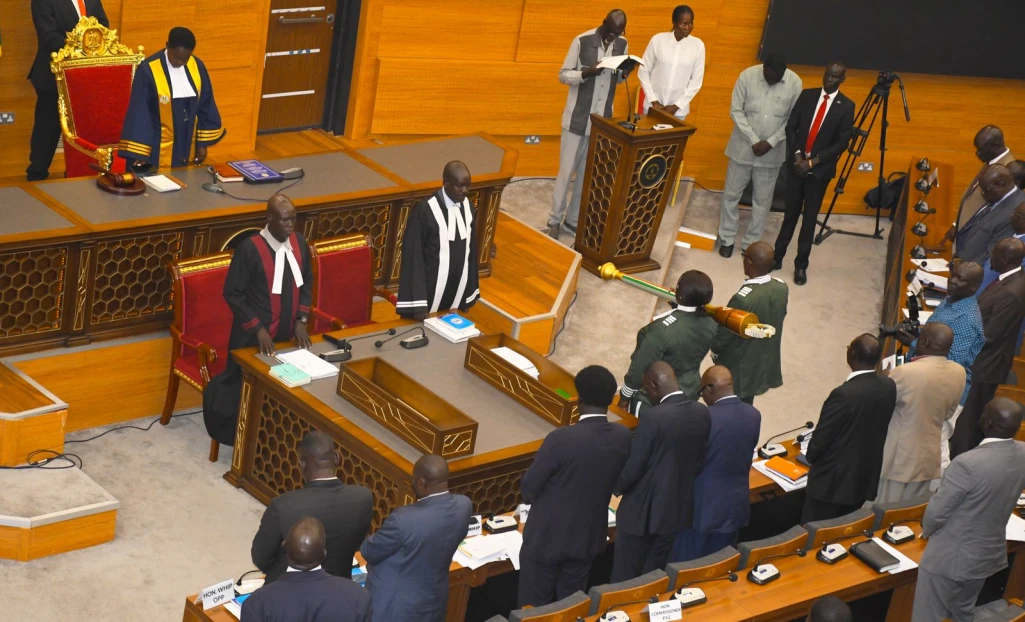
The Transitional National Legislative Assembly (TNLA) has passed the Cybercrimes and Computer Misuse Bill 2025 in its fourth and final reading, setting the stage for South Sudan’s first comprehensive legal framework to combat rising digital threats.
The bill, composed of seven chapters, aims to regulate
online conduct, strengthen cybersecurity, and provide legal grounds for
prosecuting an increasing number of cyber-related offences.
During the parliamentary deliberations, Michael Makuei
Lueth, Minister of Justice and Constitutional Affairs, emphasized the necessity
of establishing the law to empower authorities in tackling cybercrime.
“We have been suffering a lot from these computer and cybercrimes.
But we are unable to prosecute them because there is no law that gives us that
power. And this is why most of the people have run away with all these crimes,”
Makuei said on Tuesday.
“It is high time for us to control all these and bring them
to book because we are not on an isolated island. We are part and parcel of
this world. And we are part and parcel of this world, then definitely there is
need for us to have a law called cybercrime and misuse of computers.”
Makuei described the cybersecurity field as constantly
evolving.
“This law, this field is dynamic. It is not static. It is
dynamic. And as such, whatever offense that we have put here is not the last,” Makuei
stated.
He noted that additional offences should be incorporated
over time to protect citizens.
He added that continuous updates were vital “so that we
protect the people of South Sudan, so that we protect the communities, we
protect the families, we protect the children.”
The minister proposed the inclusion of cyber espionage,
cyber harassment, hacking, cyber-attacks, creation of fake electronic accounts,
fake emails, and hacking of e-payment devices as key offences.
He also recommended structural adjustments to the bill,
arguing that penalties should appear near the end of the law.
Furthermore, he defended the strong punitive measures.
“Lastly, on the question of sentences, the Honorable had
talked about it and he said these sentences are too harsh. In fact, the
sentences are even supposed to be harsher than this, so that people avoid it. Because
it is a question of fining a person 1,000,000 million SSP nowadays is nothing.
And people will say I will commit that offence and I will pay,” he explained.
“This is why in the sentences; there is fine and there is
imprisonment or both. So, the sentences, I agree that the sentences should be
kept as they are.”
Ateny Wek Ateny, Minister of Information, Communications,
Technology, and Postal Services, emphasized the need to align the new cyber
legislation with existing national security laws.
“Although the bill explicitly stated that it supersedes
other laws relevant to cybercrimes, there is a need to harmonize it with
provision of Section 13 of the National Security Service Act 2014, as amended
in 2024, which is a primary legislation safeguarding the safety of our citizen
and nation,” he said.
He also noted the importance of protecting citizen privacy
and institutional data.
Presiding over the session, Rt. Hon. Jemma Nunu Kumba,
Speaker of the TNLA, officially announced the bill’s approval.
“The Cybercrimes and Computer Misuse Bill 2025 is passed its
fourth and final reading in totality,” Nunu declared.
The Joint Report on the bill was presented by Hon. Oliver
Mori Benjamin, Chairperson of Information, Telecommunications, Communications
& Postal Services, representing the Standing Specialized Committees on
Information, Communication, Technology and Postal Services, National Security
and Public Order, and Legislation and Justice.
With the final reading completed and the seven-chapter bill approved, the Cybercrimes and Computer Misuse Bill 2025 now moves toward enactment into law.