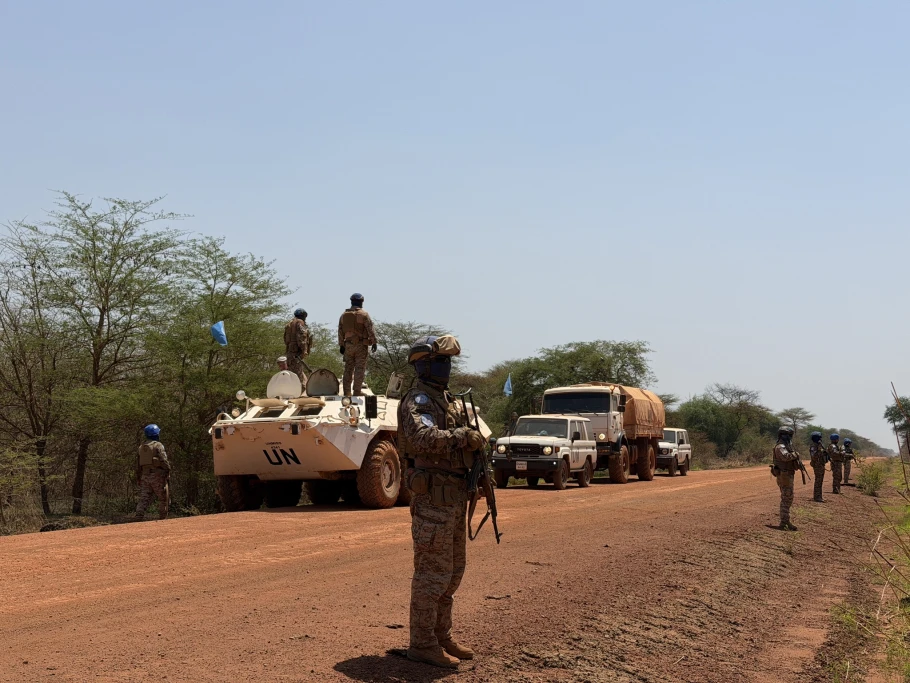
The United Nations Security Council has renewed the mandate of the United Nations Mission in South Sudan (UNMISS) until 30 April 2027, as South Sudan urged a shift in the mission’s role to better align with national priorities.
The Council on Wednesday adopted resolution 2824 (2026) by
13 votes in favour and two abstentions from China and Russia, following
negotiations marked by divisions over the mission’s future scope, political
role and force levels.
UNMISS, established in 2011 after South Sudan’s
independence, operates under a mandate supporting the 2018 Revitalized Peace
Agreement, which formed the basis of the country’s transitional government in
2020. The mission is tasked with protecting civilians, supporting humanitarian
assistance, monitoring human rights violations and backing the peace process.
The renewed mandate maintains these core functions but
reduces authorized force levels to 12,500 troops and 2,101 police personnel,
down from previous ceilings, amid financial and operational constraints
affecting UN peacekeeping globally.
South Sudan calls for changes in UNMISS mandate
Following the vote, South Sudan said the mission should
evolve in line with progress achieved under the peace process and growing
national institutional capacity.
Ambassador Sabino Edward Nyawella Amaikwey, Deputy Permanent
Representative of South Sudan to the United Nations, said UNMISS should support
national priorities rather than operate in parallel to state institutions.
“It is essential that the Mandate of UNMISS evolves in a
manner that reflects the progress achieved and supports nationally owned
priorities,” he said.
He said international support should complement national
efforts.
“We therefore call on our partners to continue accompanying
us, not in substitution of our efforts, but in support of our nationally led
path toward lasting peace and development,” Amaikwey said.
He reiterated that responsibility for peace, security and
civilian protection lies primarily with national authorities.
Amaikwey also called for clearer separation between UNMISS
operations and diplomatic frameworks governing international engagement.
“UNMISS is exclusively guided by the Status of Forces
Agreement (SOFA), while the Vienna Conventions on Diplomatic/Consular Relations
along with bilateral agreements guide diplomatic intercourse,” he said.
Divisions over mandate direction
The United States, which led negotiations on the resolution,
pushed for a more focused mandate centred on civilian protection, humanitarian
access and accountability, arguing that UNMISS had expanded beyond its core
priorities.
Washington also raised concerns over restrictions on UN
operations in South Sudan, including limitations on movement, access and
implementation of humanitarian activities.
Several Council members, including the United Kingdom,
France, Greece and Latvia, supported a more streamlined mandate, saying it
would make the mission more efficient and better aligned with current realities
on the ground.
Concerns over reduced scope
China and Russia abstained, warning that the revised mandate
and reduced troop ceiling could weaken UNMISS at a time of continued
insecurity.
Other members expressed concern that narrowing the mission’s
political role could undermine implementation of the peace agreement and
preparations for national elections. Several African members stressed that
UNMISS continues to provide essential technical and political support for South
Sudan’s transition.
The Democratic Republic of the Congo, speaking also for
Liberia and Somalia, said the mission remains critical given its institutional
experience in supporting electoral processes and governance reforms in South
Sudan.
Troop ceiling compromise
The Council rejected an initial US proposal to reduce troop
levels to 7,000, instead agreeing on a compromise ceiling of 12,500 troops. The
mission currently has about 8,989 uniformed personnel deployed.
The adjustment is in line with ongoing financial pressure on UN peacekeeping operations, as well as operational constraints affecting mobility, patrol coverage and protection capacity in South Sudan.
Some members also pushed for stronger language on elections,
regional cooperation, gender issues and human rights monitoring, parts of which
were retained in revised form during negotiations.
The Council said it will continue to review the situation in South Sudan and assess implementation of the mandate in the coming months as the country continues its political transition under the Revitalized Peace Agreement.