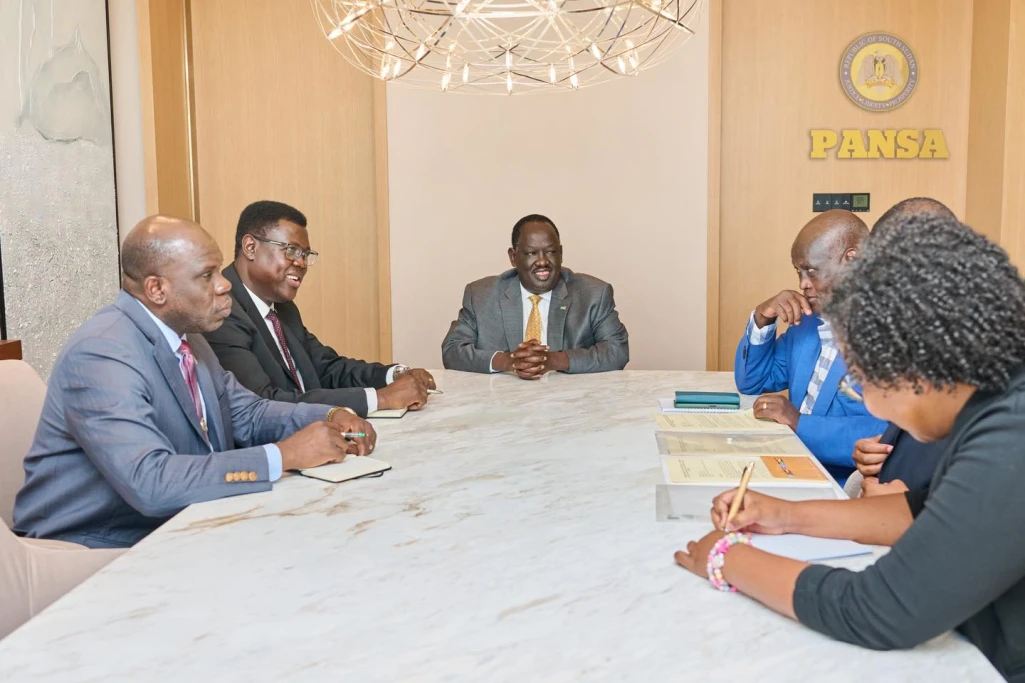
The Kenya-led Tumaini Initiative has handed over a new framework in Nairobi on January 29 to guide peace talks for South Sudan, the initiative said in a statement on Saturday.
Chief Facilitator of the initiative, Lt. Gen. Lazaro K. Sumbeiywo (Retired), handed over the framework to President Salva Kiir’s National Security Advisor, Tut Gatluak Manime, on Thursday in Nairobi. He proposed that the talks resume on February 9, 2026, and conclude within four weeks.
“This marks a critical step toward a transparent and
accountable South Sudanese‑led and South Sudanese‑owned inclusive national
consensus that charts a clear pathway to the successful conclusion of the
transition through timely, credible, free, and fair elections,” Sumbeiywo said.
The framework notes that President William Samoei Ruto will
work closely with President Salva Kiir to ensure the process enjoys “sovereign
ownership, national legitimacy, and effective political anchoring,” reflecting
a South Sudanese-led initiative supported regionally.
The framework is intended to guide deliberations on a draft
National Consensus Charter for Peace and Democracy. Discussions are expected to
focus on pre-election priorities, including cessation of hostilities, civilian
protection, humanitarian assistance, and pre-election power-sharing.
Longer-term issues for the elected government include
permanent constitution-making, transitional justice, durable solutions for
displaced persons and refugees, security sector transformation, and the
unification of forces with disarmament, demobilization, and reintegration
(DDR).
“The process moves away from adversarial posturing and
zero-sum negotiations, and instead promotes a people-centred model focused on
collective problem-solving and national ownership,” Sumbeiywo stated.
Participants are also expected to “refrain from advancing
narrow individual, party-political, sectarian, or ethnic agendas, and to
prioritize the supreme interests of the people of South Sudan—peace, security,
dignity, transparent and accountable governance, and democratic choice.”
The framework has been shared with leaders of the Sudan
People’s Liberation Movement-in-Opposition (SPLM-IO), opposition leaders of the
United Peoples’ Alliance, civil society representatives, the South Sudan
Opposition Movements Alliance (SSOMA), and the South Sudan Council of Churches.
Previous Tumaini talks, launched in May 2024 at President
Kiir’s request, were adjourned for the third time on February 7, 2025, without
concrete outcomes. The South Sudan government has not yet commented on the
proposed resumption of talks.
South Sudan has seen escalating fighting in recent months,
particularly in northern Jonglei state and parts of the Greater Upper Nile
region, between government forces and SPLA-IO fighters loyal to detained First
Vice President Riek Machar.
International and regional monitors have warned that the
deteriorating security situation, combined with stalled implementation of the
2018 Revitalized Agreement on the Resolution of the Conflict in South Sudan
(R-ARCSS), risks a return to full-scale conflict.
The Tumaini Initiative said deliberations are expected to conclude within four weeks under a regional framework that includes the Intergovernmental Authority on Development (IGAD) and support from international partners.