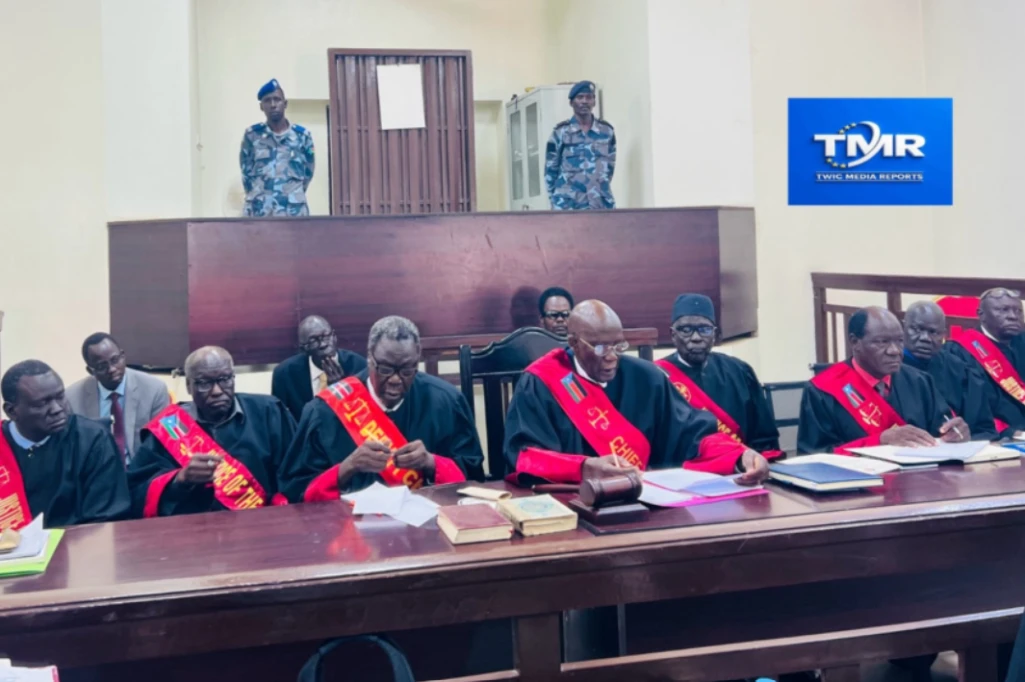
The Supreme Court on Thursday adjourned the constitutional case challenging the detention of Ambassador Ajing Deng Ajing until April 30, after granting the defense five days to review the government’s written response.
The adjournment took place during a sitting of the Constitutional Chamber presided over by Chief Justice Benjamin Baak Deng and an eight-member bench, where government lawyers formally submitted their reply to a petition challenging the legality of Ajing’s continued detention.
Ajing was relieved of his position as Executive Director in
the Office of the President in July 2025 and was later arrested in late
November 2025. He has since remained in detention without formal charges or a
court appearance, according to his legal team.
Eye Radio reported that defense lawyers Kir Chol and George Angier Ring requested
time to study the government’s submission before responding, saying they needed
adequate time to review the filing. The court granted the request and set April
30 for the next hearing.
The case centers on claims by Ajing’s lawyers that the
former senior official and serving diplomat has been held for months in
violation of constitutional due process guarantees.
The petition, filed against the National Security Service
and the Ministry of Justice and Constitutional Affairs, follows an earlier
court order that gave the government 21 days to respond to an amended petition.
At a previous hearing on April 2, the court granted the
government additional time to prepare its response, despite objections from the
defense, which had pushed for a faster determination of the matter.
Ajing’s lawyers have also argued that his arrest was carried
out without the lifting of diplomatic immunity, raising broader constitutional
questions over due process, personal liberty, and the handling of diplomatic
protections under South Sudanese law.
Beyond the central petition, Thursday’s session also
addressed procedural matters. The Constitutional Chamber affirmed that parties
may be represented by multiple accredited lawyers, reiterated that English
remains the court’s working language, and underscored the supremacy of the
Transitional Constitution in proceedings before the court.
The bench also cautioned legal representatives on courtroom
decorum, including dress standards, and announced an interim measure
restricting representation of government institutions before the chamber to
senior legal officials pending regulatory review.
The case is being closely watched as a test of
constitutional safeguards and the limits of security-related detention, with
legal observers saying the outcome could carry wider implications for the
enforcement of the Bill of Rights.
Hearings resume on April 30.