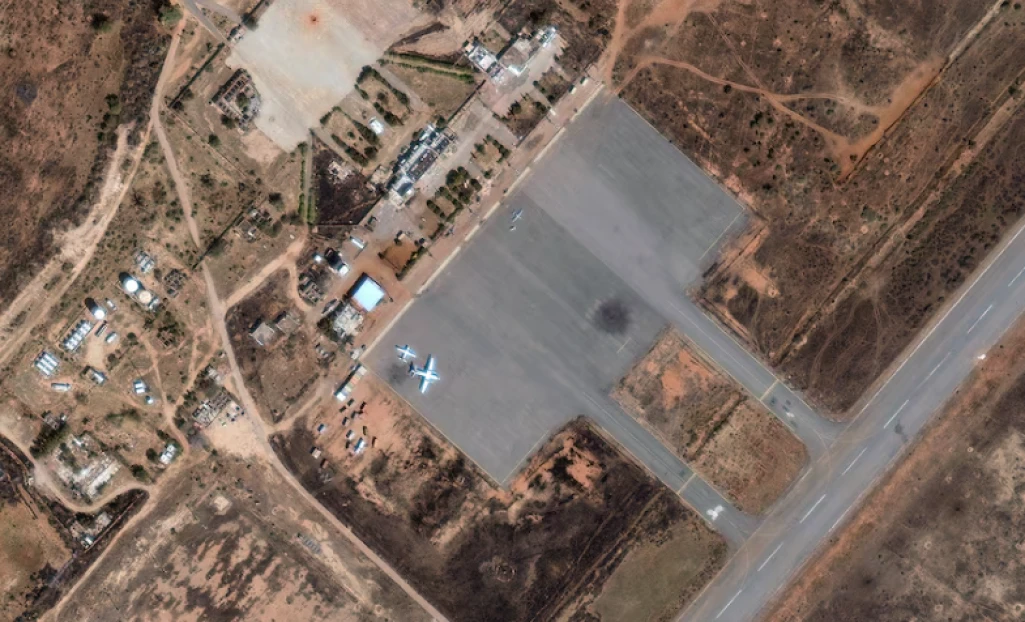
Satellite
images show at least three drones and the construction of hangars at an airport
in South Darfur held by Sudan's Rapid Support Forces (RSF), evidence of the
continuing stream of increasingly advanced weapons fuelling a devastating war.
Nyala is an
RSF stronghold and a base for its offensive on the city of al-Fashir, the last
holdout in the wider Darfur region controlled by Sudan's army and its allies.
The RSF has also targeted the nearby, famine-stricken
Zamzam camp for displaced people.
Drones have
been used by both the paramilitary RSF and Sudan's
army as the two factions, drawing on foreign
support, have battled each other in a
conflict that erupted from a power struggle in April 2023.
The war has
left tens of thousands dead and caused the spread of acute
hunger and disease.
The images,
captured by Maxar, track the construction of three hangars over a five-week
period between January and February.
At least one
drone first appeared at the airport on December 9, 2024, according to Maxar
imagery analysed by Reuters.
Yale
researchers reported the presence of drones at the airport in January.
Analysis by
the defence intelligence company Janes determined that the drones pictured are
Chinese-manufactured CH-95s, capable of long-range surveillance and strikes at
a distance of up to 200 km.
Reuters could
not independently confirm the identity of the drones or how they arrived in
Nyala. Chinese authorities and the China Aerospace Science and Technology
Corporation, which produces CH95s, did not immediately respond to requests for
comment.
The army has
previously accused the RSF of using Nyala airport to receive weapons from the
United Arab Emirates, which it says has supplied drones to the RSF throughout
the war.
These looted
supplements sold on Bukavu's streets in Congo have raised health concerns.
In response
to a request for comment, the UAE foreign ministry said the UAE had
"already made absolutely clear that it is not providing any support or
supplies to either of two belligerent warring parties in Sudan", and that
it was focused on humanitarian relief.
A
spokesperson for the RSF said allegations of Emirati support had "no basis
in truth."
"The
Rapid Support Forces do not possess modern drones, the ones who possess them
are the army," he said.
Nyala air
strikes
Reuters
reporting last year showed that planes from the UAE were flying into
an airport near the Sudanese border with Chad, likely to provide arms to the
RSF.
Activists and
residents of al-Fashir say drones from Nyala have shelled civilian targets in
the city, including the city's last
remaining major hospital.
In return,
Sudan's army has repeatedly targeted Nyala and its airport, including with air
strikes that have killed civilians, according to local activists and
humanitarian workers in the area.
One such
campaign occurred on February 3, killing 32 people according to medical charity
MSF.
Satellite
imagery shows evidence of at least five new strikes from apparent army
bombardment close to the Nyala drone hangars between January 14 and February
18.
An RSF source
and a Western security analyst said the downing of an army plane on Sunday
evening demonstrated new RSF anti-aircraft capabilities at Nyala. A local
humanitarian source said the aircraft bombed the airport twice before it was
shot down by anti-aircraft fire.
Three
aircraft experts said the downed plane was very likely an Ilyushin 76 cargo
plane - similar to one downed
in North Darfur in October - based on footage showing pieces of the
engine and landing gear.
Videos posted
online and verified by Reuters show crowds gathering by the plane's burning
wreckage. Reuters geolocated the site to northern Nyala, about 1 km from
al-Mustaqbal neighborhood.
The Sudanese
army did not respond to requests for comment about evidence of drones in Nyala
or bombardment of the area.
Darfur would
be the most important territory for a government the RSF is
forming with allied politicians as the geographical splinters caused
by the war deepen.
A U.N. arms
embargo on Darfur since the early 2000s has failed to stop a steady stream of
foreign weapons entering the country.