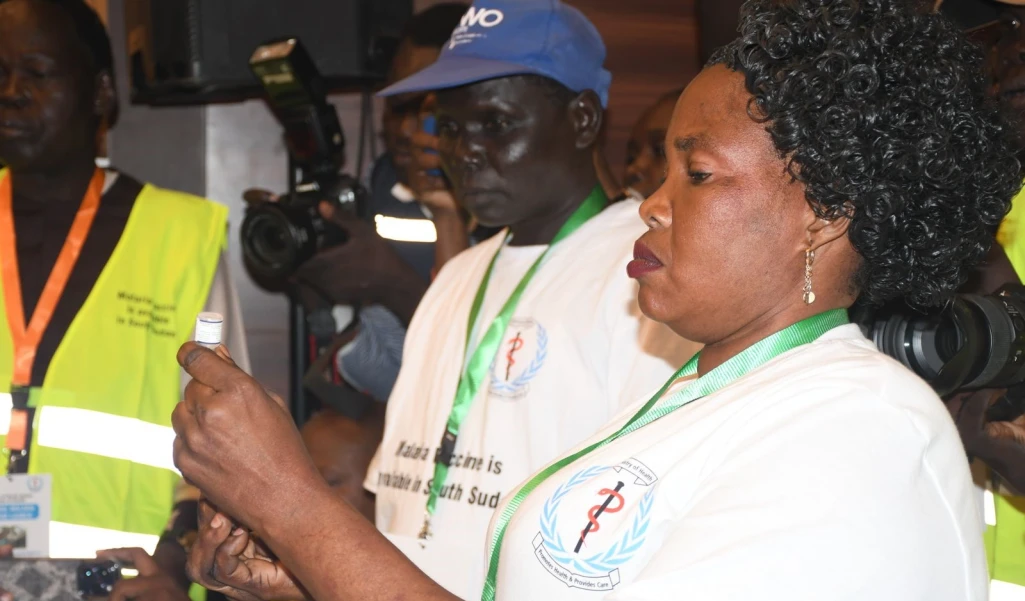
In a
historic effort to accelerate the fight against malaria in children aged 5–18
months, the Ministry of Health, in partnership with UNICEF, the World Health
Organization, and Gavi, launched the nationwide rollout of the R21 malaria
vaccine on Tuesday.
The launch
follows the arrival of the first consignment of over 64 5,000 doses of the R21
malaria vaccine in Juba on May 31, 2024.
These
vaccines were distributed to the 28 counties with the highest malaria burden,
with plans to scale up the rollout nationwide.
As malaria
disease continues to be a leading cause of illness and death in South Sudan,
this landmark event marks a significant stride in the country's efforts to
safeguard the health and well-being of its children.
In 2022,
South Sudan reported an estimated 2.8 million cases and 6,680 deaths, with
approximately 7,630 new cases and 18 fatalities daily, making it one of the
countries with the highest malaria incidence rates in the region.
Speaking at
the vaccine launch in Juba, Hussien Abdelbagi Akol, vice president for Service
Cluster, stated that the vaccination process requires critical supervision of
the health workers.
“Storing
vaccines requires specialized facilities, while administration must be handled
by well-trained and experienced medical personnel. This is to ensure safety of
the vaccination process,” Akol stated.
Akol
directed the states, counties, authorities, community leaders, faith-based
organizations, civil society organizations, and the media to support the
vaccination campaign through mass mobilization and dissemination efforts.
The VP
stresses the need to educate citizens, especially parents, on the impact of the
vaccine.
“There are
always negative thoughts and beliefs surrounding vaccination, spread out of
fears and stigma. We need to work collectively together to repel such negative
and reassure the society about the safety and importance of the malaria
vaccination,” he stated.
Yolanda Awel
Deng, the Minister of Health, encourages families to continue to use
long-lasting insecticide-treated nets.
“Malaria
vaccine is not a silver bullet. It is not, we are done. It is only going to
reduce the impact of the disease on the body,” Awel stated.
“The malaria
vaccine introduction will begin in 28 counties across six states in South
Sudan, starting with Central Equatoria, Eastern Equatoria, Western Bahr El
Ghazal, Northern Bahr El Ghazal, Warrap and Jonglei State.”
According to
Awel, the high malaria burden led to the selection of the areas to maximize
health benefits.
The Ministry
of Health aims to vaccinate approximately 265,897,000 children in five to 18
months with a series of four doses as a complementary intervention to existing
malaria interventions.
Meanwhile,
Hamida Lasseko, UNICEF South Sudan Representative, calls on health workers to
ensure the availability of the vaccine.
“I encourage
them to ensure vaccine availability at fixed sites during outreach and mobile
services and ensure appropriate communication to the caregivers on the new
vaccines and other immunization services,” Lasseko stated.
Lasseko
further echoed, “We pledge our continued support to strengthen the supply chain
and foster demands for vaccines to ensure equitable access for all children in
South Sudan, leaving no child behind.”