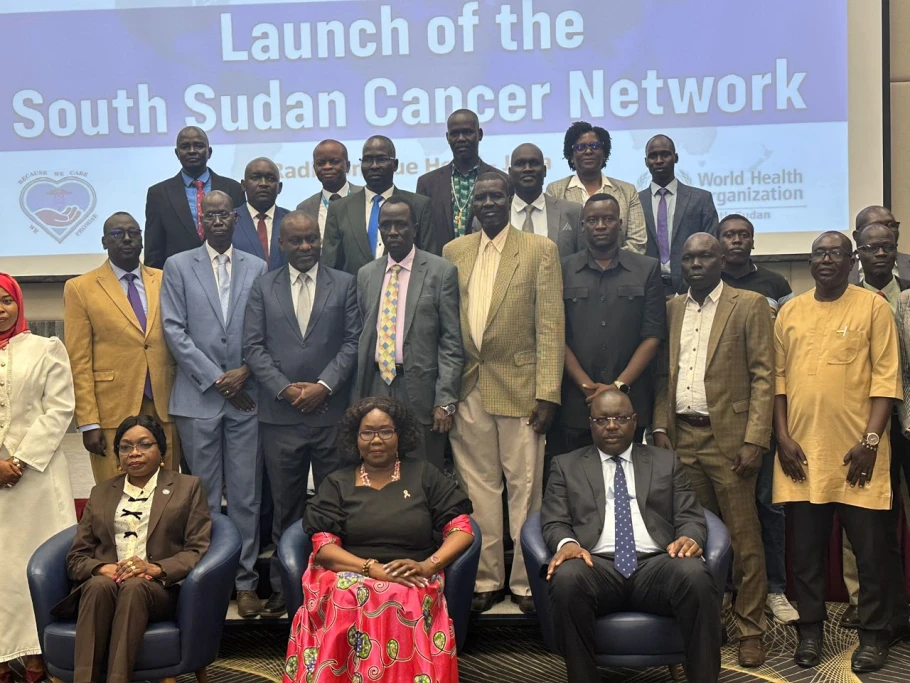
South Sudan has launched the Cancer Network as the country faces a growing cancer crisis. The announcement was made on World Cancer Day on Wednesday, bringing together government officials, health partners, and civil society organizations.
The Governor of Central Equatoria State, Emmanuel Adil
Anthony, pledged government support by donating land in Yei County for cancer
services. He emphasized the need for early detection, stronger health systems,
and capacity building for healthcare workers.
“This is a decision and we need to support persons who are
diagnosed with cancer as a government. I met the leaders of the South Sudan
Cancer Network; we have two places. One in southern Juba, and we have single
like Yei which is ready. Whichever way you choose, Yei is not far away from
here,” Adil said
“Let us establish a cancer registry to know the number of
people with cancer, as the number may be higher due to lack of testing and
early detection.”
Health Minister Sarah Cleto highlighted the challenges of
limited funding and heavy reliance on donor support.
“We as a country have 85% of our budget for health coming
from our donors and our supporters. And we need to meet the 50% which we are
not meeting. We are offering less than 2% of that. And this has been affecting
our health services,” Cleto.
Despite funding gaps, the ministry has established a cancer
department and developed protocols to guide interventions. Plans are underway
to open an oncology unit at Juba Teaching Hospital, with the goal of eventually
creating a comprehensive cancer center.
The WHO Representative, Dr. Humphrey Karamagi, warned that
cancer accounts for 7% of deaths in South Sudan, with breast, cervical,
prostate, liver, and colorectal cancers as the top killers.
Dr. Steven Francis, Vice President of the Cancer Network,
said the initiative will coordinate nationwide efforts to detect cancer early
and improve treatment outcomes.
“The inauguration of South Sudan Cancer Network marks a
significant milestone in our journey toward coordinated and inclusive and
sustainable response to the cancer,” Francis said.
“Together, we can build the future where cancer is detected
earlier, treated effectively and faced with hope rather than fear.”
World Cancer Day, observed annually on February 4, aims to raise awareness, educate the public, and drive action. The launch of the Cancer Network represents a major step toward a coordinated and sustainable national response.