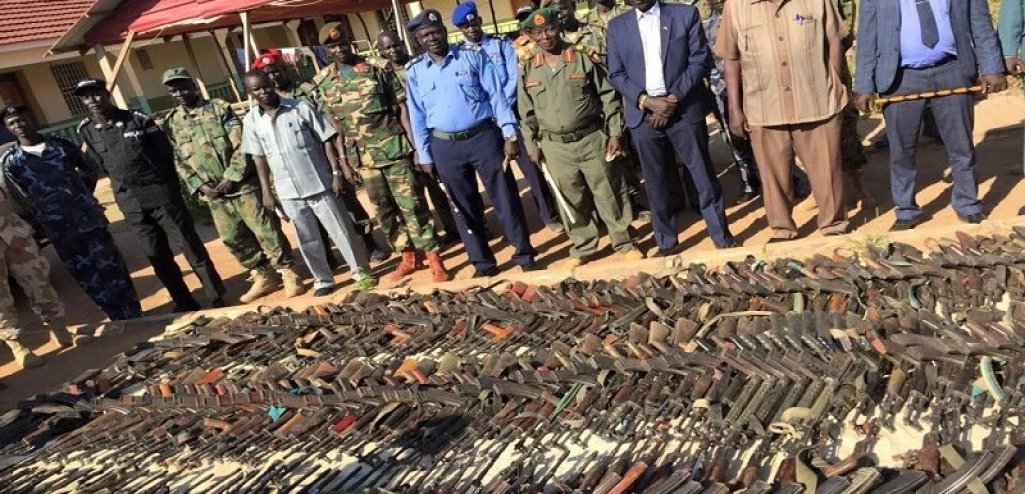
Many civilians in South Sudan have illegal weapons, causing
local bloodshed, communal strife, and instability, a situation blamed on a weak
administration and profound tribal divisions for failing disarmament.
Despite past efforts and presidential directives to remove
firearms from communities, many believe the government has not done enough to
implement disarmament.
In 2023, President Salva Kiir directed the Minister of
Defense and Veteran Affairs, General Chol Thon Balok, to carry out
disarmament across the country, but the event never happened.
Marino Lokuru, a resident of Kapoeta in Eastern Equatoria
State, expressed his concerns about the government’s inability to enforce
disarmament effectively.
“To disarm the communities has got a lot of challenges; the
wings of the government are very weak, and they are not performing well. The
whole of South Sudan, the communities are militarized,” Lokuru said.
“Disarming civilians has no problem, but the executive
or the government is the problem because they live on tribal lines. Let them
first sit as leaders of this nation.”
Other citizens believe that creating awareness and learning
from other countries’ experiences could help facilitate disarmament.
One who preferred to only be called Akulino suggested, “The
government should first create awareness in the communities on the dangers of
having arms, and when trying to disarm them, they should be given something to
calm them down. Let the government also find some strategies that other
countries used when disarming their citizens.”
Bagi Sukar is another resident who advocates for the
involvement of local authorities through a registration system for peaceful and
voluntary disarmament.
“Let all chiefs of Greater Kapoeta come together and
register all households who have guns, and during the disarmament, it will be
very easy to identify who has the gun and how many,” he proposed.
Garang Chok, a chief in Aweil East, Northern Bahr el Ghazal
state, emphasized the importance of voluntary disarmament programs,
recommending that the government implement initiatives that encourage civilians
to surrender weapons willingly.
“Implement voluntary disarmament programs that engage
directly with local communities. This could involve offering incentives,
amnesty, or community-led initiatives to encourage the surrender of weapons,”
Garang stated.
Legal frameworks can also play a major role in curbing
civilian armament. Mama Makada Zakaria urged the government to take strict
legal measures.
“Enact laws that make civilian possession of arms a criminal
offense, with appropriate penalties. This sends a clear message and provides a
legal framework to support disarmament efforts,” Makada stated.
Article 50(1) of the South Sudan Firearm Act, 2016, states
that, “Any person who is in possession of a firearm without a valid license,
permit, or authorization commits an offense and is liable, upon conviction, to
imprisonment for a term not exceeding ten years, a fine to be determined by the
court, or both.”
Beyond disarmament, addressing the root causes of communal
violence is essential. Santino Kuol from the Ruweng Administrative Area called
for dialogue among conflicting communities.
“Facilitate open dialogues between the conflicting
communities to address the root causes of the violence. This could involve
traditional conflict resolution mechanisms, as well as government-led
initiatives that bring all stakeholders to the table,” he said.
Meanwhile, Lual Miyen Lual from the Abyei Administrative
Area highlighted the need for strengthening security forces to maintain peace
post-disarmament.
“Invest in building the capacity and professionalism of
South Sudan’s security forces, ensuring they can maintain law and order without
excessive force. This includes training, equipment, and oversight mechanisms,”
Miyen urged.
Socioeconomic issues also drive communal violence. In an
interview with The Radio Community in 2023, a peacebuilding official, the
undersecretary of the Ministry of Peacebuilding, Pia Phillip, stated
that he believes disarmament would not help the situation if the
economic challenges are not addressed.
“I don’t buy that idea [disarmament]. That’s a secondary
issue. It’s not about the guns; it’s about what else they can use to survive
and earn a living,” Phillip said.
Maria Nyadeng Magem from Warrap State urged the government
to tackle these root causes.
“Implement programs that address the underlying
socioeconomic drivers of the conflicts, such as poverty, lack of economic
opportunities, and competition over scarce resources. Providing alternative
livelihoods and economic development can reduce the incentives for communities
to resort to violence,” she urged.
Despite numerous disarmament efforts by the government,
firearms continue to circulate among the youth, with civil society groups
attributing the phenomenon to political failures.
Over 70 percent of South Sudan's population is under 30, and
USAID reports that many lack education, skills, and employment opportunities.
Although disarmament initiatives have persisted for years, firearms remain a serious problem. Citizens attribute the situation to government weaknesses, a lack of trust, and the failure to tackle underlying societal issues.