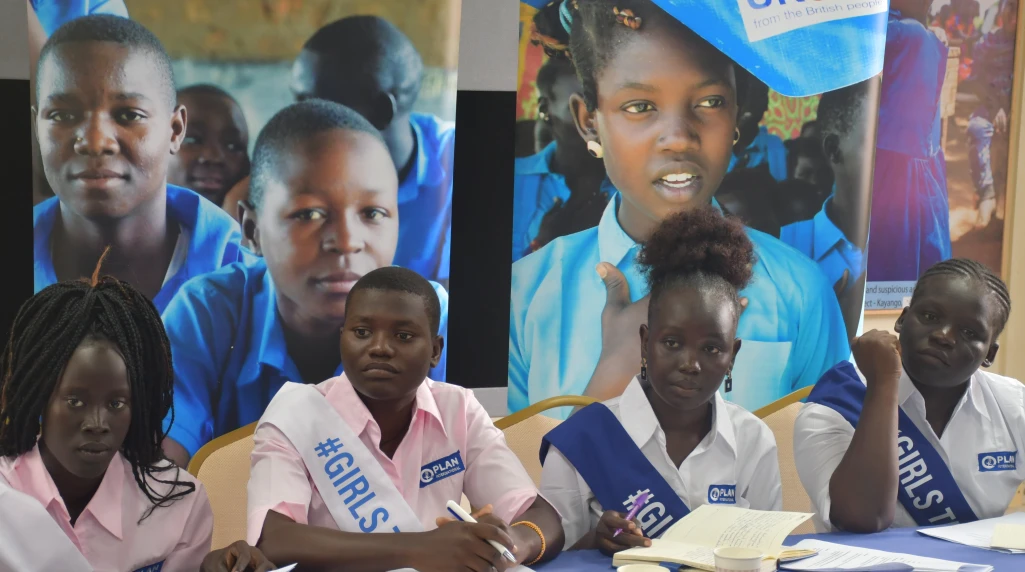
During a “girls' takeover" event on Thursday in Juba, these passionate young girls expressed concerns over deep-rooted issues such as biased scholarship distribution, early marriages, and limited access to education.
Alanyo Daphine, a 16-year-old girl from Nimule town, said she has often seen scholarships awarded to boys, while girls in need, including orphans, are left out of these educational opportunities.
“We have found that some of the girls face unfair and biased scholarships. You find that girls who are financially stable are given scholarships, and the ones who are not financially stable are left out,” said Daphine.
"This is where the tribalism comes in. The person who is responsible for scholarships might be from the tribe of the person given the scholarship, but the vulnerable, the orphans, the ones who need the scholarship are left out."
Daphine urged for change in the education sector, emphasizing the potential of girls, drawing inspiration from Tanzania’s female president, Samia Suluhu Hassan.
“Let the scholarships be given to the vulnerable girls. Those who are financially stable should let the ones who are financially down be able to access education so that they can be better people in the future,” Daphine stated.
“Like we have a female president in Tanzania, if we support these girls by giving them proper education and mentor them in leadership roles, we can become leaders of tomorrow because when you educate a lady, you educate the whole nation.”
As of 2024, girls’ education in South Sudan remains dire. Around 2.8 million children are out of school, with girls representing a bigger portion of this number.
Meling Rejoice, a 17-year-old girl from the Greater Pibor Administrative Area—an area prone to cattle-related conflicts with neighboring communities in Eastern Equatoria and Jonglei states—highlighted the cultural challenges faced by girls in South Sudan.
“There are many challenges girls face in South Sudan, including cultural norms; some of these girls are forced into early marriage, and some even are married off while still in the womb, and when the child is born, she is told her bride price has been paid and she must go to her husband’s place. This is not really, good,” said Rejoice.
“Girls need to go to school and study instead of marriage. Most of these girls’ rights are being violated by their parents. Girls cannot talk, they are told to do whatever their parents wish.”
One of the major factors contributing to the low education level of girls is cultural practices such as early marriage, which affects 52% of girls in South Sudan and leads to their marriage before they reach the age of 18.
Additionally, a high rate of teenage pregnancy and gender disparities in scholarship distribution contribute to the dropout rate among girls.
Akuach Miabek, another 17-year-old girl from Ruweng Administrative Area, touched on the stigma young mothers face, explaining how early pregnancies lead to social rejection.
“The ones who are responsible for these early pregnancies most reject these girls at the end, and the girls end up taking care of themselves and their babies,” Miabek said.
Despite this, Miabek encourages young mothers to continue pursuing their education.
“I always tell some girls that becoming a young mother at a young age does not stop you or disqualify you from continuing your education,” she stated.
Despite efforts to increase girls' access to education, such as cash transfer programs and school enrollment initiatives, challenges remain.
Factors like insecurity, poor infrastructure, and a lack of trained teachers also play a part in keeping girls out of school.
Emmanuela Jabe pointed out the limitations in education infrastructure, especially in rural areas.
“Sometimes poor education systems lead to early and forced marriages. You find in some areas, there are only primary schools, and even those might only go from primary one to primary four,” Jabe explained.
Many families cannot afford to send their daughters to school outside their towns, forcing girls to stay home.
Passionate Jabe and her peers are advocating for systemic changes that prioritize education and protect girls from harmful cultural practices, stressing that learning is the key to shaping their futures and their communities. The girls voice their concern during the “Girls takeover” event in Juba.
The "Girls Take Over" initiative is organized by Plan International and aimed at empowering young girls in leadership roles.
This year, Emmanuela Jabe and Alanyo Daphine took over the role of UK Ambassador while Akuach Miabek served as the Canadian Ambassador, and Meling Rejoice was the Norwegian Ambassador for a day.