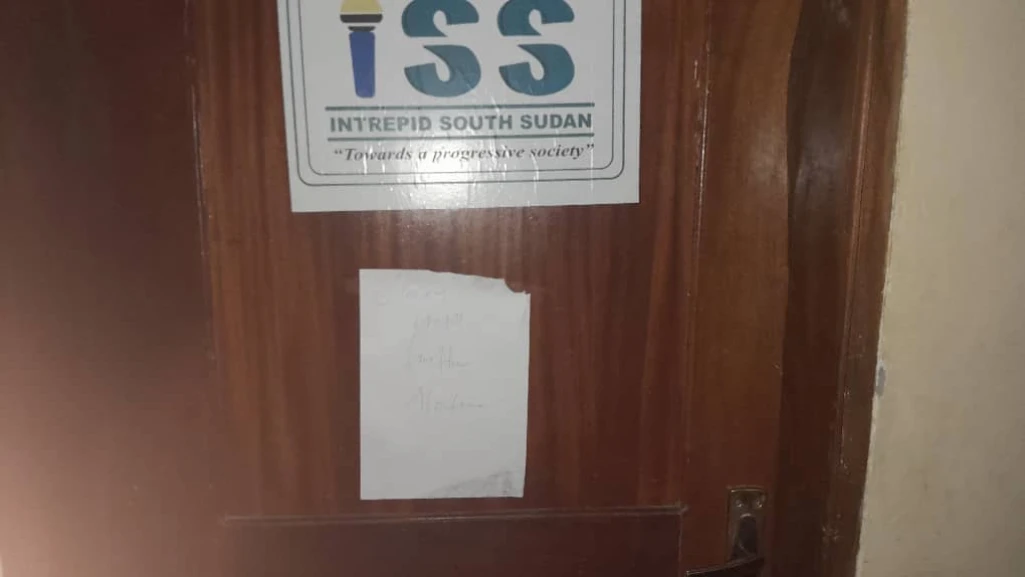
The leader of Jonglei State's Civil Society Network has
protested the National Security Service's decision to close the INTREPID South
Sudan office in Bor.
NSS officers sealed the INTERPID office on Tuesday after
accusing the organization's executive director, Bol Deng Bol, of orchestrating
a pay strike last week.
Hundreds of civil servants had demonstrated against the high
cost of living, demanding that the government pay their seven-month salaries.
This caused the state security service to arrest civil
society members and close their operations.
Bol, who has since fled the town, feels that the security
forces illegally closed his organization, claiming it had nothing to do with
the demonstrations.
“It is very illegal, and we are very concerned because NSS
is acting by force,” Bol told Mingkaman FM via phone from an undisclosed
location.
“As we are speaking, our activities are now affected because
everything is locked inside the office, and our staff are at risk now because I
am now hiding.”
INTREPID South Sudan is currently implementing an advocacy
program dubbed the Public Excellence Award, supported by the Canadian Embassy
in South Sudan.
Meanwhile, Peter Ajak, a member of the civil society network
in the state, said he was concerned about the staff and beneficiaries of the
projects implemented by INTREPID amid the South Sudan economic crisis.
“We need the state authorities to open the office to allow
the activities to continue,” he explained.
Both local human rights watchdogs and UN agencies have said
that civic and political space in South Sudan is shrinking dramatically.
Civil society and ordinary citizens, whose voices are
crucial in calling for accountability, are also reporting being excluded from
governance processes, according to the UN Office of the High Commissioner for
Human Rights.
“Overall, accountability for violations and abuses of human
rights and international humanitarian law remains lacking, in a context of
impunity, absent or weak judicial infrastructure, and lack of political will,”
Volker Türk said in 2023.