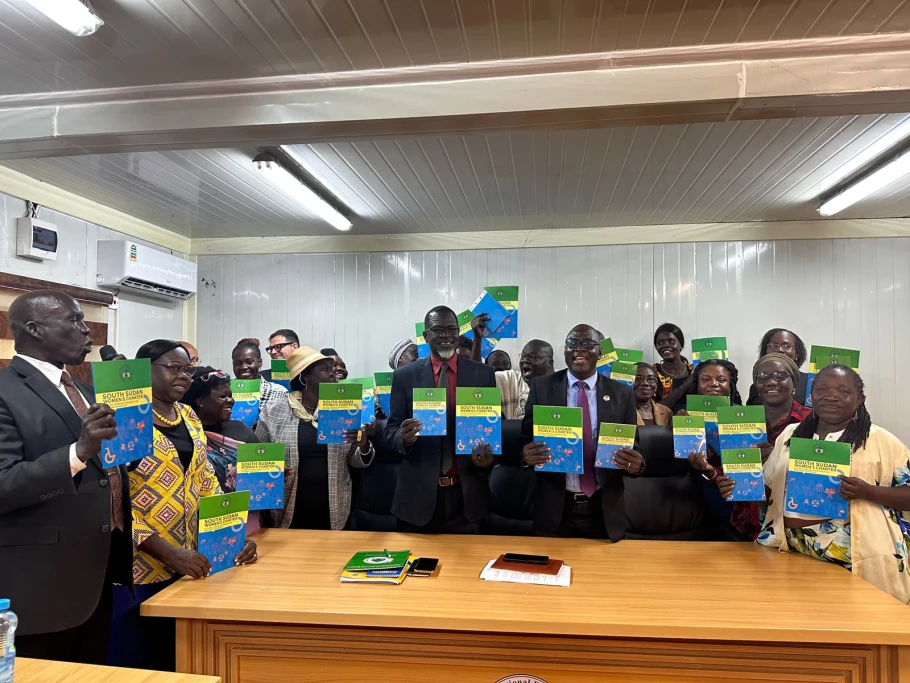
The National Constitutional Review Commission (NCRC) has received the South Sudan Women’s Charter, marking a milestone for women in the country’s constitution-making process.
Dr. Riang Yer Zuor, the Chairperson of the National
Constitutional Review Commission (NCRC), emphasized the importance of the
submission and explained how the Charter fits into the wider framework of
drafting the permanent constitution.
“It is therefore in this regard and in accordance with
section 12, subsection 6 of the act that the women charter is being publicly
submitted to the NCRC as a position of the women of South Sudan on nationally
identified issues that are of utmost importance to them specifically and to the
whole country in general,” Yer said.
Dr. Riang cited that the constitution making process is
designed to be people driven, with citizens expected to play an active role at
every stage. He said civic education and consultations are essential for
ensuring meaningful participation.
“It is important to point out here that the purpose of civic
education is to enlighten the people of South Sudan on the process so that they
are aware of the role that they are expected to play as this process is said to
be led and owned by the people of South Sudan,” he said.
Speaking at the event, the Undersecretary in the ministry of
parliamentary affairs James Francis emphasized that the Women’s Charter
addresses the broad spectrum of women’s needs and priorities.
“So the charter addresses 12 key thematic areas as we heard
from the previous speakers, ranging from political participation, health
education, economic empowerment, protection against violence and climate
security. This reflects the diverse needs and priorities of women and girls in
South Sudan as we all know,” Francis said.
He added that the Charter is more than a document, it is a
pivotal tool for ensuring women’s rights and gender equality are embedded in
the nation’s legal framework.
“the charter serves as a critical tool for integration of
women's rights and the gender equality principles into the South Sudan's
permanent constitution and we know this is now like we have always shared with
women and even other civil society organizations that this is the final moment
for South Sudanese to fight and make sure the voices of citizens and everybody
is included in this permanent constitution,” he added.
The submission of the Charter represents a collective effort
by Women, Civil society organizations, government institutions, and development
partners to guarantee that women are central to the country’s governance,
development, and peace building efforts.