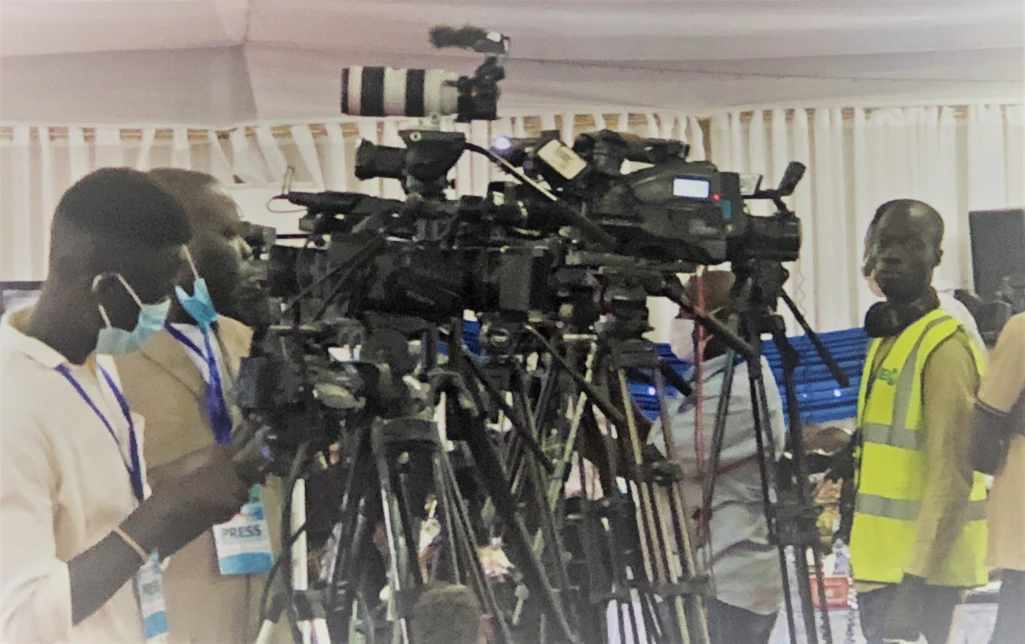
South Sudanese journalists cover Sudan peace talks in Juba in 2022 | Credit | Courtesy
Media practitioners in South Sudan have been urged to promote accurate and responsible reporting on labour migration, as unemployment, irregular migration, and exploitation continue to affect thousands in the country.
The call was made during a media roundtable organized by the
International Labour Organization (ILO) under the Better Regional Migration
Management programme, funded by the UK FCDO, in Juba.
Aida Awel, ILO Technical Advisor, said migration is a
defining feature of East and North Africa, with millions moving in search of
better opportunities.
“Globally, we say there’s 281 million migrants and 167.7
million migrant workers. Migration today is a defining feature of the region
millions of people are on the move within and across borders,” Awel said.
She noted that South Sudan is simultaneously a country of
origin, transit, and destination, with many young people migrating due to
limited formal job opportunities.
“South Sudan is very much part of this dynamic, and it's
simultaneously a country of origin, transit, as well as a destination for many
migrants. With a predominantly young population, many entering the labor
market, with limited formal opportunities, migration becomes not only an
aspiration, but often a necessity for most young people,” Awel said.
Awel warned that many migrant workers face unsafe working
conditions, exploitation, and abusive recruitment practices, while highlighting
the positive role of remittances in supporting families and local economies.
“Too many workers face risks of exploitation, abusive
recruitment practices, unsafe working conditions, and limited access to
justice. At the same time, migration also brings opportunities. When we do have
a family outside the country, we expect them to send us some money, and to call
remittance. So remittance in our region supports many households, contributes
to local economies, and can play a critical role in the development and the
recovery of the country,” she said.
Agasio Akol Arop, Chair of the Subcommittee on Labour and
Industries, highlighted the challenges journalists face in reporting migration,
including political pressure and safety concerns.
“The role of journalist is very big and very complicated. at
this time it is very dangerous. Because to deliver message when you are meeting
people from other areas, moving, migrating from that country to another
country, you have a challenge. You can be forced by the relevant authority to
report positively when the case is not the case,” Arop said.
He urged journalists to rely on verified data and strengthen
cross-border collaboration.
“Professionals need people, journalists to work together
with those in the same country such that to get accurate information, how to
report the information about the migration. Collect the reliable data. Don't
just take information. The first information sometimes it cannot be accurate.
But when you analyze that information, you can be able to get good
information,” he added.
Pasquale Micheal, Secretary General of the South Sudan
Workers Trade Union Federation, said high unemployment and economic hardship
are driving migration, particularly among youth.
“Unemployment has created one of the very challenging points
in terms of migration. We are speaking of 30-something percent unemployment
this plays a direct impact into people migrating,” Micheal said.
He warned that South Sudan continues to face significant
internal displacement and external migration, describing the situation as
alarming.
“We can speak of 2.4 million refugees externally abroad in
Uganda, which is one of the very big challenges and the situation is alarming.
Not only abroad, but also we have the long internal displaced people who are
still in the country since the starting of the crisis in this land since 2013,”
he said.
Micheal called on authorities and stakeholders to address
the root causes of migration through job creation, fair employment, and
stronger labour systems.
The roundtable brought together media professionals, government officials, employers, and workers’ representatives to improve cooperation on safe, regular, and fair labour migration. Participants agreed that responsible journalism, combined with policy reforms and economic opportunities, is key to protecting vulnerable workers in South Sudan and the region.