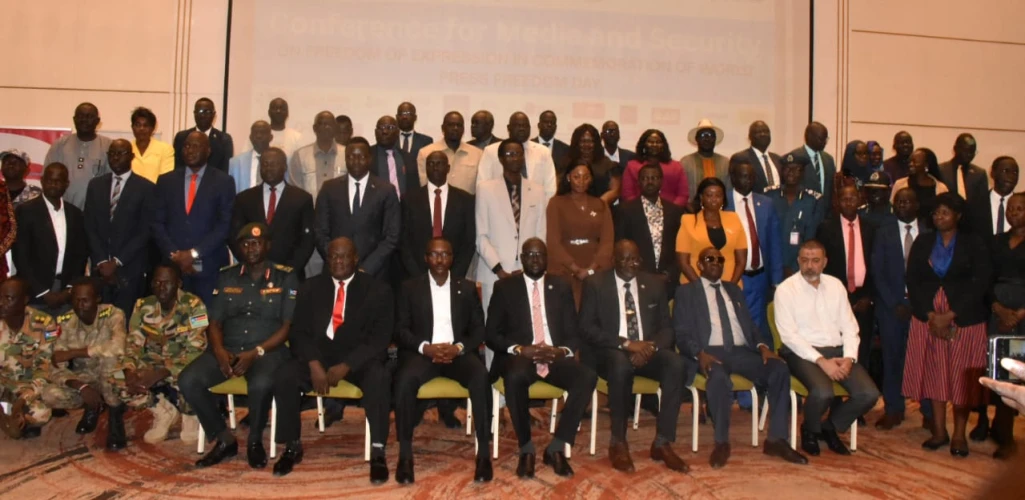
Stakeholders on Tuesday convened a three-day Security and Media Conference in Juba aimed at strengthening press freedom, promoting responsible journalism and improving relations between media and security institutions ahead of South Sudan’s planned December 2026 elections.
Ateny Wek Ateny, Minister for Information, Communication,
Telecommunication and Postal Services, emphasized the importance of cooperation
between journalists and security agencies.
“We recognize that press freedom and freedom of expression
are constitutional rights that must be protected within the framework of the
law, professionalism and ethics,” Ateny said in a statement seen by The Radio
Community (TRC).
“The relationship between media and security institutions
should not be defined by confrontation, fear, or mistrust. It should be guided
by cooperation, professionalism, dialogue, and mutual respect,” he added.
Abdul Wadood, UNESCO Officer in Charge, said free and
independent media is critical as the country prepares for elections.
“Press freedom is a foundation for peace, development and
democratic participation,” Wadood stated.
He echoed that journalists must be allowed to work safely
and independently to ensure citizens access reliable information ahead of the
elections.
Patrick Oyet, Chairperson of the Union of Journalists of
South Sudan (UJOSS), highlighted the broader role of press freedom in
protecting human rights and maintaining peace.
“Press freedom promotes other freedoms. When the press is
free to report, then other human rights can be protected, and people can speak
freely about when they are violated. Press freedom can help promote peace in
society,” Oyet explained.
Robert Iga Afedra, Acting Country Director for Norwegian
People’s Aid, called for the continued growth of a professional and independent
media sector in South Sudan.
“It is our wish to see an ever-evolving, professional fourth
estate in South Sudan that not only provides constructive scrutiny of
government but also champions the voice of people and provides a strong
platform for tomorrow’s media practitioners to develop,” Iga expressed.
Held under the theme “Shaping a Future at Peace: Promoting
Press Freedom, Human Rights and Development, through Elections,” the conference
marks World Press Freedom Day 2026 and focuses on the role of journalism in
promoting peace, democratic participation, public trust and sustainable
development.
The conference is organized by UNESCO in partnership with
the Ministry of Information, Communication, Telecommunication and Postal
Services and media organizations, with support from the Japan International
Cooperation Agency and Norwegian People’s Aid.
Over the three days, participants are expected to discuss
practical measures to protect journalists both in the field and online,
strengthen cooperation between media and law enforcement agencies, support
responsible election reporting, counter hate speech and misinformation, and
promote information integrity in an increasingly digital environment.
Despite progress in the media sector, journalists and
international organizations continue to raise concerns over intimidation,
censorship, restricted access to information, insecurity, limited resources and
pressure facing media practitioners across the country.