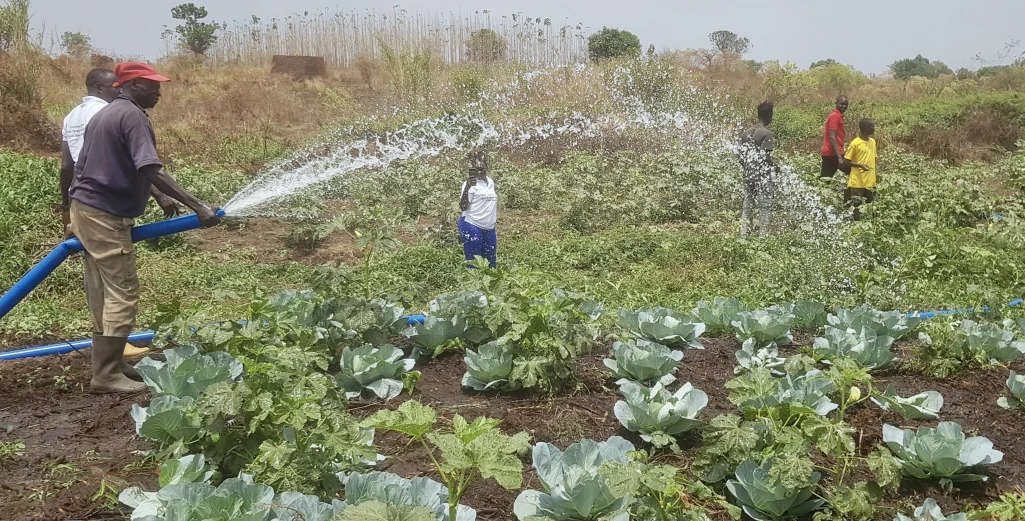
A farmers
group in Magwi County and a cooperative in Yei River County have received
irrigation pumps to improve farming during the dry season.
The project
"Community-Driven Rural Development (CDRD)" by GIZ South Sudan aimed
to improve the living conditions of rural communities.
On March 4
and 12, 2025, the pumps were handed over to local communities, enabling farmers
to grow crops and vegetables year-round.
The project's
capacity development approach to farming as a business integrates it, resulting
in significantly increased crop production and income.
“With the
installation of irrigation equipment, I am convinced that our group will be
able to sufficiently boost the water supply for better crop growth and
increased vegetable production,” said Oringa Youny James, vice chairperson of
Wang Acholi Vegetable Group, Magwi County, during the pump handover and testing
in a press statement.
Meanwhile,
his counterpart, Festo Ade, chairperson of Kembe One Cooperative Group, Yei
River County, said:
“With
off-season vegetable production, the farmers are expected to fetch better
prices, enabling them to increase their household income.”
The groups
plan to sell their harvests in local markets, improving food and nutrition
security.
The activity
includes long-term training, a pump maintenance plan, and agricultural
equipment to ensure sustainability. It also encourages young people and women
to pursue vegetable farming as a business.
CDRD is
jointly funded by BMZ and the Embassy of the Kingdom of the Netherlands and
implemented by GIZ as part of a four-year cooperation.
The project
promotes high-yield, agroecological, and climate-adapted agriculture to improve
living conditions and economic prospects in rural areas.
It advises
regional administrations and civil society on development planning, focusing on
conflict prevention and gender equality.
The project
also helps smallholder farmers, women, youth, and community agricultural
organizations access production means, markets, and services.