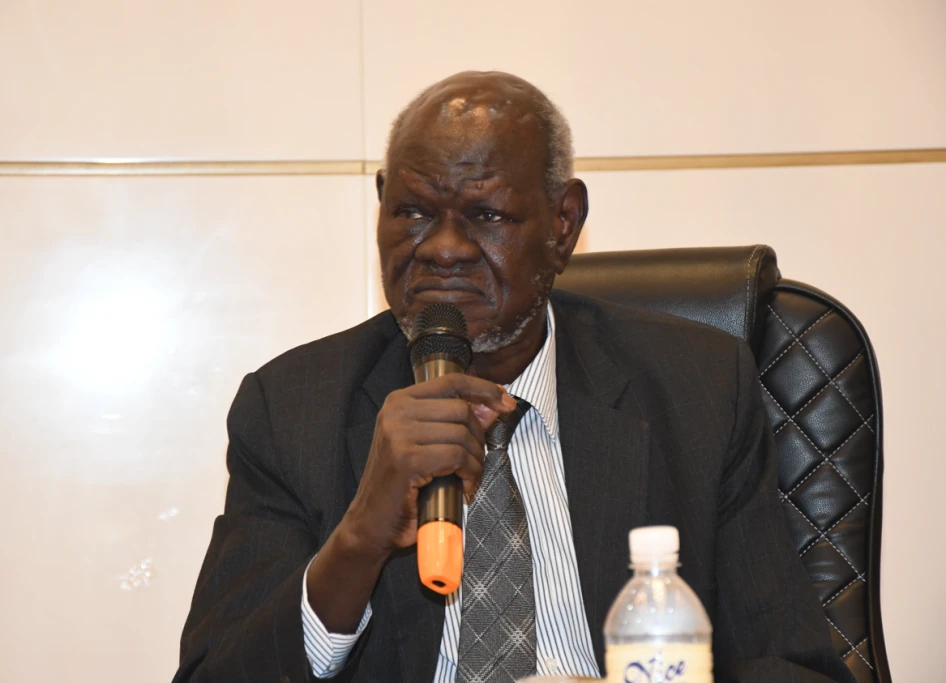
Prominent South Sudanese politician and academic Prof. Peter Adwok Nyaba says South Sudan is not yet a nation, arguing that ethnic identity still outweighs national identity nearly 15 years after independence.
Speaking during a national identity dialogue in Juba, Nyaba
said the country remains socially and politically organized along ethnic lines
despite decades of liberation struggle and years of statehood.
“South Sudan is not a nation. South Sudan is a multiplicity
of ethnicity, culture, language and religion. Therefore, it would be inaccurate
to categorize it as a nation,” Nyaba told participants at a three-day forum organized
by the University of Juba in partnership with the United Nations Mission in
South Sudan (UNMISS).
The discussion formed part of wider debates on citizenship,
constitutional reform and nation-building as South Sudan works towards a
permanent constitution.
Nyaba argued that many South Sudanese continue to identify
first with their ethnic communities rather than the state, weakening efforts to
build national cohesion.
“Whether you are in the village or in the city like Juba,
activities revolve around ethnicity because we are still organized, not as a
nation, but as ethnicities or clans,” he said.
According to Nyaba, nationhood cannot emerge automatically
after independence but must be deliberately built through inclusive governance,
shared institutions and equal citizenship.
“From 1946 to today, it is about 80 years, yet we remain as
ethnicities, which means a problem has occurred somewhere with the political
leadership. Because nationhood is constructed. It does not come by itself,” he
said.
Nyaba blamed political leadership for failing to transform
South Sudan’s ethnic diversity into a shared national identity.
He rejected suggestions that ethnic diversity itself is
responsible for conflict in South Sudan, instead linking instability to
political exclusion and unequal distribution of power and resources.
“The conflict we are having now is political. It has nothing
to do with ethnicities. Conflict comes if you correlate ethnic pluralism with
inequality in the distribution of state power and resources. Not because of the
number of ethnicities, but because of the mismanagement of the diversity,”
Nyaba said.
He traced the identity crisis to colonial-era governance
that grouped southern communities under one territory while maintaining ethnic
separation.
Nyaba said colonial authorities in 1928 identified six
indigenous languages for development, including Dinka, Nuer, Shilluk, Bari,
Otuho and Zande, but said this did not create a shared national identity.
He called for governance systems that ensure representation
for smaller communities often excluded due to population size.
“There must be a system that includes all these groups as
South Sudanese,” he said, reviving an earlier proposal for a “House of
Nationalities” to guarantee broader inclusion.
Nyaba maintained that South Sudan’s nation-building crisis
stems not from cultural diversity itself, but from the failure to manage
diversity fairly and build institutions based on equality and justice.
“The crisis of nation-building in South Sudan does not arise
from ethnic multiplicity, nor from cultural diversity, but from the failure of
the political elite to manage this ethnic diversity and to build governance
systems based on justice and fraternity,” he said.
The dialogue in Juba brought together government officials, academics, civil society representatives and development partners to discuss national identity, citizenship and peacebuilding as part of South Sudan’s ongoing constitution-making process.