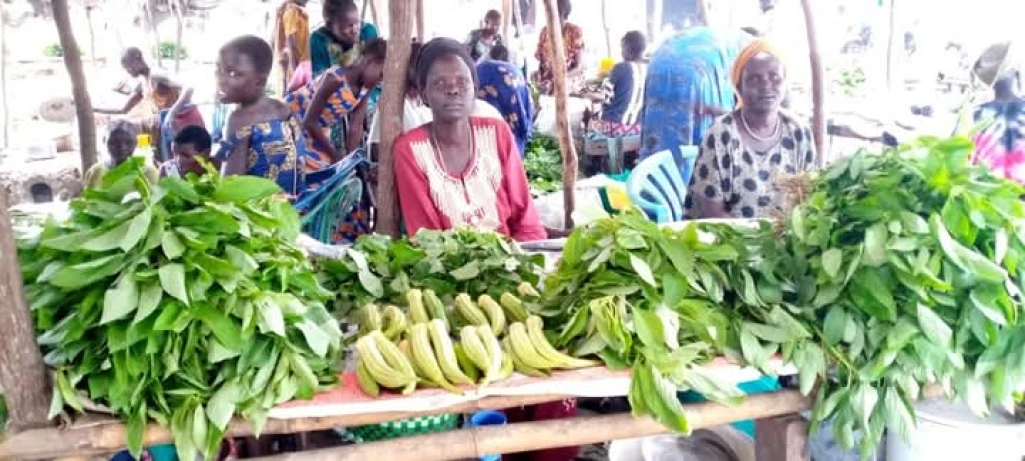
As South Sudan deepening economic crisis hit harder, women in Bor town step up as the primary pillars of survival for their families. Despite the biting prices, limited job opportunities, and an unsupported local economy, they are finding ways to cope, survive, and support their loved ones.
For 48-year-old Mama Rebecca, a mother of five, the sun
barely rises each morning as she wakes up early to prepare her vegetables and
takes a walk to the nearly two-kilometer Marol market to sell and make ends
meet.
"Life is not easy in the market here because when you
buy something today, tomorrow the prices will not be the same. Sometimes we go
to bed without eating because there’s no money. The little money I get, I use
it to pay school fees, buy medicine, and cook for my children,” Rebecca
narrated.
Displaced to Uganda by the 2013 conflict, Rebecca returned
in 2014 as a returnee and started a small shop selling assorted food items,
later adding vegetables. Today, she stands strong as a single mother, managing
hardship and rising above it despite ongoing currency depreciation.
"Despite the dollar issues, I’m still committed. This
business has helped me educate my children. My only son finished Senior Four,
two others are in Senior Three. I’ve even built a house. It’s not easy, but
it’s worth it,” Rebecca stated.
Despite losses from her vegetable business due to rising
market prices, Rebecca remains determined, urging other women to work hard and
support each other to overcome the dollar crisis.
The struggle is never-ending, and Rebecca is not alone in
fighting the tough economy. Rachel Aduai, a single mother of six, within the
same market, is also part of the movement.
She owns a restaurant known for its beloved fish dishes and
local meals. Once a small tea and chapati shop, it is now an eatery that
employs 10 other women. However, rising market prices and taxes threaten its
survival.
"My sales have dropped almost by half. People ask for
prices and walk away. We’ve had to reduce what we offer Taxes, insecurity, and
inflation are making it harder to even stay open pass sunset,” Aduai lamented.
In the same race is 35-year-old Amol Deng, who sells chunks
of wild meat on the roadside in Bor after losing her home to the floods of
2020. This has become her only lifeline, providing for herself and her family.
"There is nothing I get here, only a kilo of meat for
my children and a little money maybe 50,000 SSP. It’s not enough for school
fees or medication,” Amol said.
As the rainy season approaches, coupled with wildlife
restrictions, Amol is worried about the survival of her business, since the
local hunters she relies on will struggle to access wild animals.
While Women Rise, What About the Men?
The struggles of strong and resilient women like Rebecca,
Rachel, and Amol have not gone unnoticed. Some men have not forgotten their
responsibility to provide for their families and support the women in their
lives. One man stepped up to champion women’s empowerment.
Lual Kuol Aleng, a local businessman who has observed
women’s struggles in Bor Town market, described how he witnesses their daily
efforts to provide for their families, selling salty fish, collecting firewood,
or even traveling to East Africa for goods at the watched of their husbands.
"Men are mostly idle now. Some help with farming or
ride motorbikes for money. But women, they are the backbone. Even when sick,
they are in the market, trying to feed families,” Lual described.
Lual, who had been bringing goods from Khartoum before the
Sudan conflict, shared his personal story and how household dynamics have
shifted over time.
"I now help my wives at home I used to do clothing
business from Khartoum to Bor, but with Sudan’s conflict and border closure, we
shifted. We sell salty fish now. Taxes are too high, profits are low, but we
try,” Lual explained.
USAID Cut Amplify Hardship
Rhoda Nyankiir Makuei, chairlady of the Women’s Rights
Organizations Network in Bor, said the suffering of women has been worsened by
the USAID cuts, and the government is falling short of meeting the needs of the
local population.
"Women are suffering due to inflation. Most empowerment
programs have stopped, especially after USAID cuts. We are trying to link them
with microfinance and vocational training, but support is very limited,”
Nyankir said.
Despite the challenges, Rhoda believes in the resilience of
Bor’s women, who, despite the soaring economy, continue to be in the market,
feed their children, and survive.
She calls on the government and partners to invest in
programs that support women during this difficult time.
Amid relentless economic hardship, women in Bor town stand
as the community’s backbone, displaying fierce determination despite scarce
resources.
South Sudan’s economy remains vulnerable due to its reliance
on oil, political instability, and lack of infrastructure. Hyperinflation, a
weak currency, and high unemployment worsen poverty.
Since gaining independence in 2011, South Sudan has been
plagued by conflict, hindering peace efforts and stalling economic development.
Editor’s Note: This story is reported with a grant from Journalists for Human Rights under the 'Tackling Mis/Disinformation Project,’ funded by the Peace and Stabilization Program of the Government of Canada.