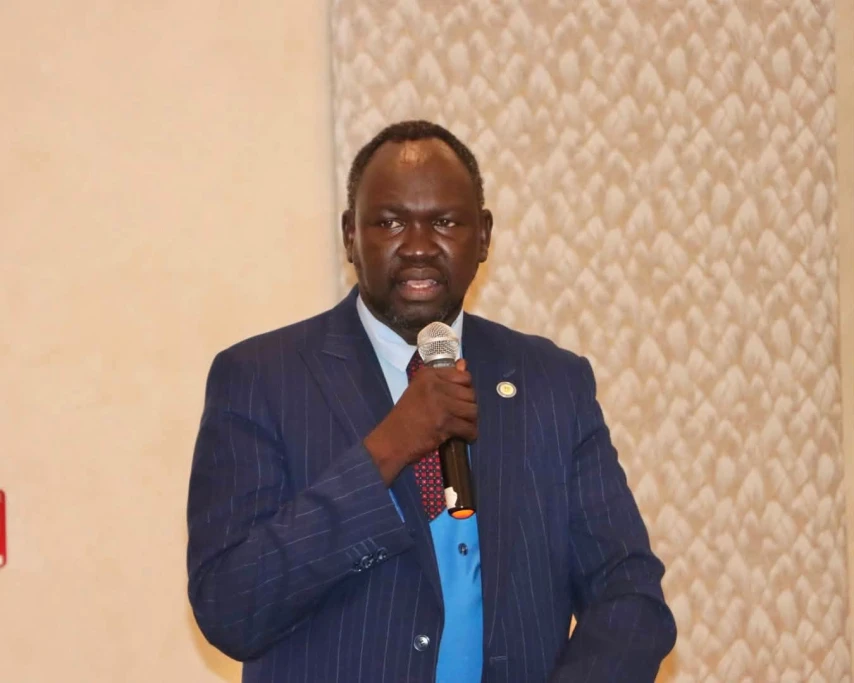
The National Public Health Institute (NPHI) has urged the public to remain vigilant against Ebola, warning that South Sudan remains at high risk due to its proximity to the ongoing outbreak in the Democratic Republic of the Congo (DRC).
“The threat of Ebola is there. We are at high risk. Our proximity to Ebola, our weak health system, and our health care services are very limited,” Dr. Kediende Mapuor Chong, NPHI Executive Director, told The Radio Community (TRC) in an interview on Tuesday.
Mapuor called on citizens to take personal responsibility by
avoiding unnecessary physical contact, washing their hands regularly with soap
and water or using hand sanitizer, and reporting suspected cases immediately.
“Protect yourself, protect your family, protect your
community. Let us all be responsible for protecting this country from Ebola,” he
said.
He advised anyone experiencing symptoms such as fever,
headache, body aches, stomach pain, vomiting or diarrhea, especially those who
have recently traveled to Ebola-affected areas or attended the funeral of a
suspected Ebola victim to seek medical attention without delay.
“Anybody with symptoms like Ebola, especially with a travel
history to Ebola-affected countries or after attending the funeral of someone
who died of Ebola, should report to the nearest health facility or call our
hotline number, 6666,” he explained.
The NPHI has identified 15 counties as high-risk areas. These
include four counties in Central Equatoria State, six in Western Equatoria
State, and five in Eastern Equatoria State.
Officials said communities along the border maintain close
social and trade links with neighboring areas in the DRC's Ituri Province,
increasing the risk of cross-border transmission.
Last week, the Ministry of Health announced that all 13
suspected Ebola samples tested by the national laboratory returned negative
results.
Uganda has officially declared the end of its 2026 Ebola
outbreak after recording 20 confirmed cases, including 18 recoveries and two
deaths.
However, the Democratic Republic of the Congo continues to battle its largest-ever Ebola outbreak, with more than 3,600 confirmed Bundibugyo-virus cases and about 1,587 deaths reported across 49 health zones in five provinces.