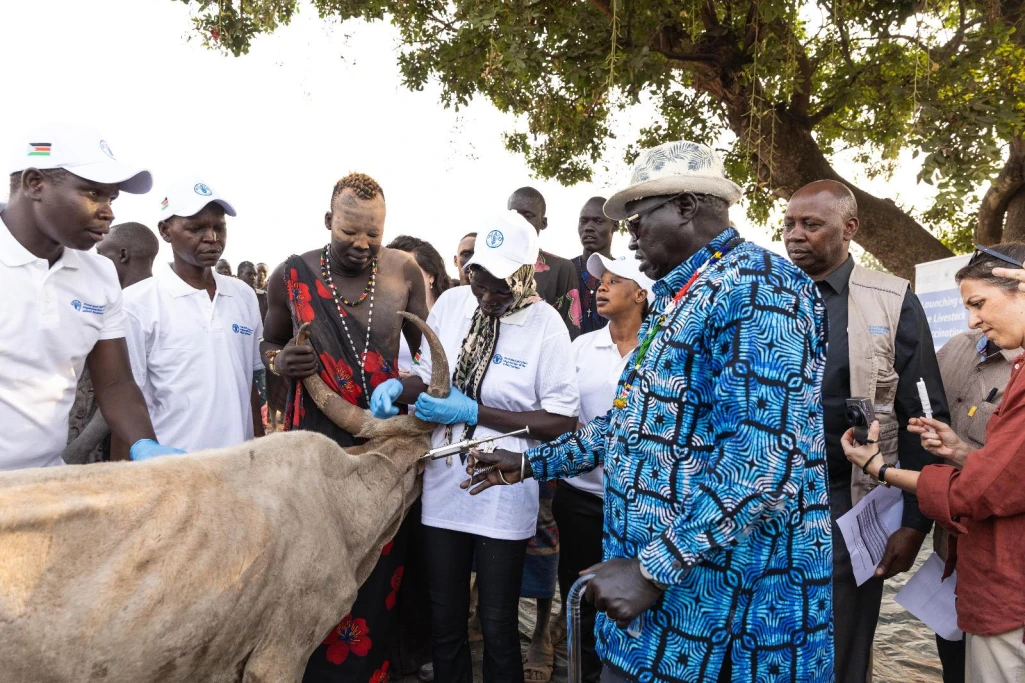
South Sudan has launched a nationwide livestock vaccination campaign targeting more than 10 million animals in 2026.
The program aims to protect cattle, sheep, goats, poultry,
and dogs from major infectious diseases that threaten livelihoods and food
security.
The campaign was officially launched in Dijeri Boma, Ladu
Payam, Juba County, Central Equatoria State, by the National Ministry of
Livestock and Fisheries in collaboration with the Central Equatoria State
Ministry of Animal Resources, Fisheries and Tourism.
It is being implemented in partnership with the Food and
Agriculture Organization of the United Nations (FAO) and other development
partners.
Under the program, cattle will be vaccinated against Black
Quarter, Contagious Bovine Pleuropneumonia, Anthrax and Hemorrhagic Septicemia.
Sheep and goats will receive vaccines for Contagious Caprine
Pleuropneumonia, Sheep and Goat Pox, and Peste des Petits Ruminants (PPR).
Poultry will be immunized against Newcastle disease, while
dogs will be vaccinated against rabies to curb transmission to humans.
With support from the European Union under the Pastoralism
and Livestock Adaptation to Climate Change in Eastern Africa programme, FAO has
also been vaccinating small ruminants against PPR in Northern Bahr el Ghazal
and other border areas.
The cross-border initiative follows seasonal pastoralist
movements to prevent disease outbreaks and build herd immunity among migrating
livestock populations.
In a statement seen by The Radio Community (TRC), FAO’s
Interim Representative in South Sudan, Felix Dzvurumi, said the agency is
working closely with the Ministry of Livestock and Fisheries at both national
and state levels to strengthen animal health systems and improve sector
planning.
Minister of Livestock and Fisheries Onyoti Adigo Nyikec
underscored the livestock sector’s potential to drive commercialization,
improve household incomes and enhance community resilience.
He said healthier, better-bred animals can significantly
increase the sector’s contribution to national economic growth.
Nyikec added that initiatives such as livestock shows and
exhibitions are helping communities recognize the economic value of improved
animal husbandry and adopt more commercial production practices.
Beyond economic gains, the minister noted that the
vaccination campaign is expected to reduce conflict linked to seasonal cattle
movements by promoting community-based solutions in border areas, thereby
contributing to peace and security.
The program also supports the One Health approach through
cooperation with the Ministry of Health and the World Health Organization,
recognizing the close link between animal health, human health and the
environment.
By protecting animal health on a national scale, authorities
say the 2026 vaccination drive aims to strengthen food systems, improve public
health and reinforce economic stability across South Sudan.