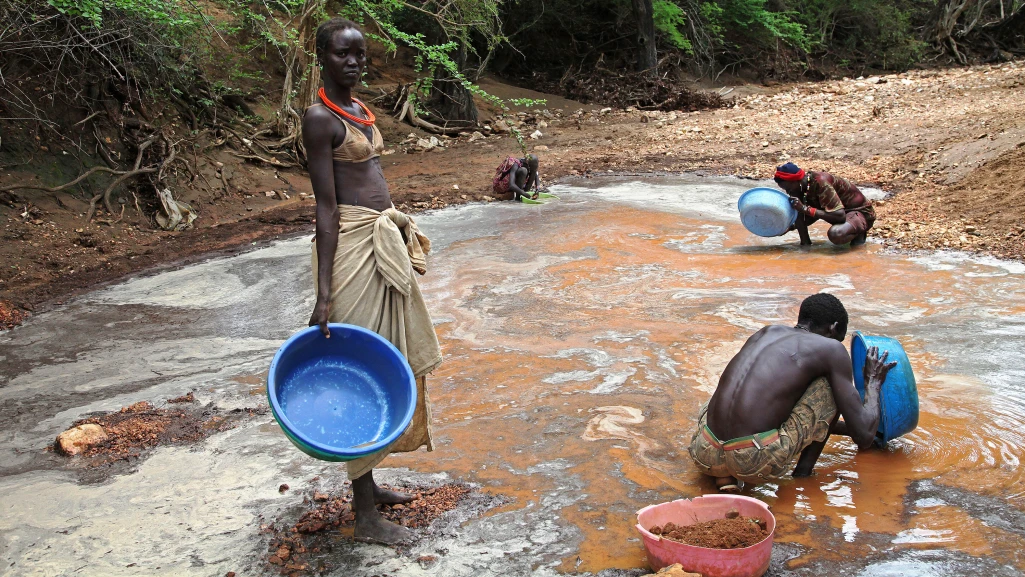
Gold miners at a site in Kapoeta | Credit | Courtesy
A gold mine collapse at the Nachilagur mining site in Kapoeta South County, Eastern Equatoria State, has left one person injured.
Commissioner Paule Lokale reported that the incident
occurred on Sunday morning when part of a mining hole collapsed on the miner,
identified as Musa Logie.
“The hole slid on him, and people came to rescue him. He was
brought to the hospital on Sunday. He was to be referred to Kenya, but the
vehicle broke down,” Lokale said.
The survivor is injured in his lower back and legs, leaving
him unable to walk. According to the Commissioner, he is on his way to Kenya
for further treatment, but the referral has been delayed due to a breakdown of
the ambulance meant to transport him.
Lokale warns miners to avoid sideways and deep holes, urging
safer alternatives to prevent accidents.
“The hole that goes sideways to meet another hole is the one
which kills people. Let people use another alternative, because if you dig
deeper, know that it is death. You leave such holes, dig an open hole, and then
go in. When it is finished, leave it and open a new one,” Lokale advised.
Experts say South Sudan is home to some of the most
important sites for artisanal and small-scale gold mining, particularly in the
Kapoeta area, Budi County, and the Luri River basin of Central and Eastern
Equatoria states.
Locals primarily use traditional techniques, panning for
gold in seasonal streams across various villages.
It’s estimated that around 60,000 miners work at 80
different sites, including Nanaknak, Lauro (Didinga Hills), Napotpot, and
Namurnyang, providing resources for their families.
However, despite a legal framework, the gold mining sector
in the Kapoeta area remains largely unregulated and criminalized, as pointed
out in a 2020 report by the Enough Project.