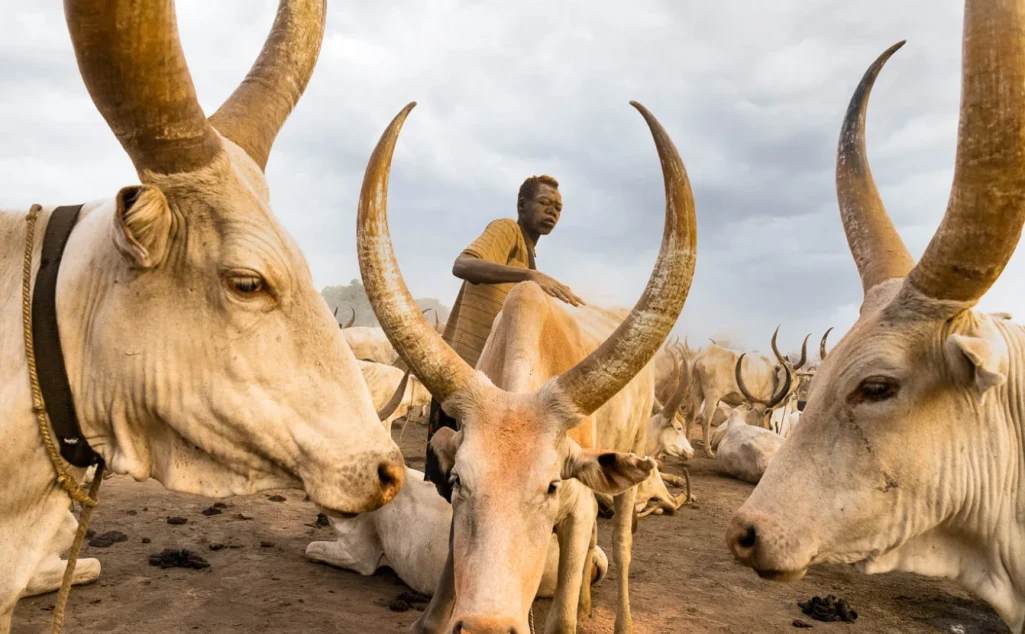
A livestock expert has called for legal frameworks and land demarcation to end recurring herder-farmer conflicts in South Sudan.
In South Sudan, cattle are deeply valued, they provide food,
represent wealth, and play a central role in marriage customs. However, despite
their importance, cattle have also become a major source of violent conflict.
Traditional practices have turned deadly due to disputes
over land, water access, and cattle raiding, often exacerbated by the
proliferation of firearms.
Environmental challenges such as flooding have worsened the
situation, forcing herders to move into new territories, sparking clashes with
farming communities.
In an interview with The Radio Community, livestock expert
Mr. John Kang Gang stressed the importance of structured cattle movement and
regulatory measures to reduce these tensions.
“One, you have to put a law that will regulate the movement
of the cattle from state to state. The second one is that you have to demarcate
the cattle routes, where the cattle can go. And also, you have to make agricultural
land," Garang said.
"They must be clear between the cattle routes and
agricultural land. And this one will solve the problem of the conflict between
the cattle owner and the crop owner."
Mr. Kang also highlighted the relevance of regional
protocols, specifically citing the Intergovernmental Authority on Development
(IGAD)’s guidelines on livestock movement.
“South Sudan is a member of IGAD region, and we have
something called transhuman protocol. Transhuman means the movement of the
people with their livestock. Every cattle owner has the right to move where
there is pasture and water," he explained.
However, he stressed that such movement must be preceded by
proper community engagement.
“Before you go to that community, you have to send people,
and then you meet the chief, and the community in that area. Then you talk with
them, and you tell them, please, I'm coming to graze my livestock. I'm coming
with my livestock to get water. Please allow me to come here for a certain
period of time. And after that, I will go back," he echoed.
Failure to honor such agreements often leads to conflict, he
noted.
"The two problems that are causing our problem here in
South Sudan especially, the intra-state movement, it is the cattle owner comes,
and then they don't go. They don't go back. They stay there. This is the big
problem," he stated.
"If a community wants to graze then they should have a
good conduct with the host community which includes good friendship."
The consequences of unmanaged movement were tragically
highlighted in January 2025, when armed individuals attacked cattle camps of
herders from Jonglei State who had moved into Magwi County of Eastern Equatoria
State. The attack, particularly in Nyolo village, resulted in at least 41
deaths and numerous injuries.
In February, the Ministry of Livestock and Fisheries
announced new regulations aimed at reducing farmer-herder tensions. However,
these measures have not yet been implemented.
Earlier that month, a peace and security conference in Juba
produced several resolutions, but tangible results have yet to materialize.
Additionally, a 2017 Presidential Order calling for the return of cattle to
their places of origin remains unfulfilled.
Similarly, Resolutions Nos. 7 and 8 from the 8th Governor’s
Forum have seen no visible progress.
Mr. Kang’s call for action underscores a growing urgency to manage livestock movement in a way that respects both traditional practices and modern governance to foster peace and coexistence.