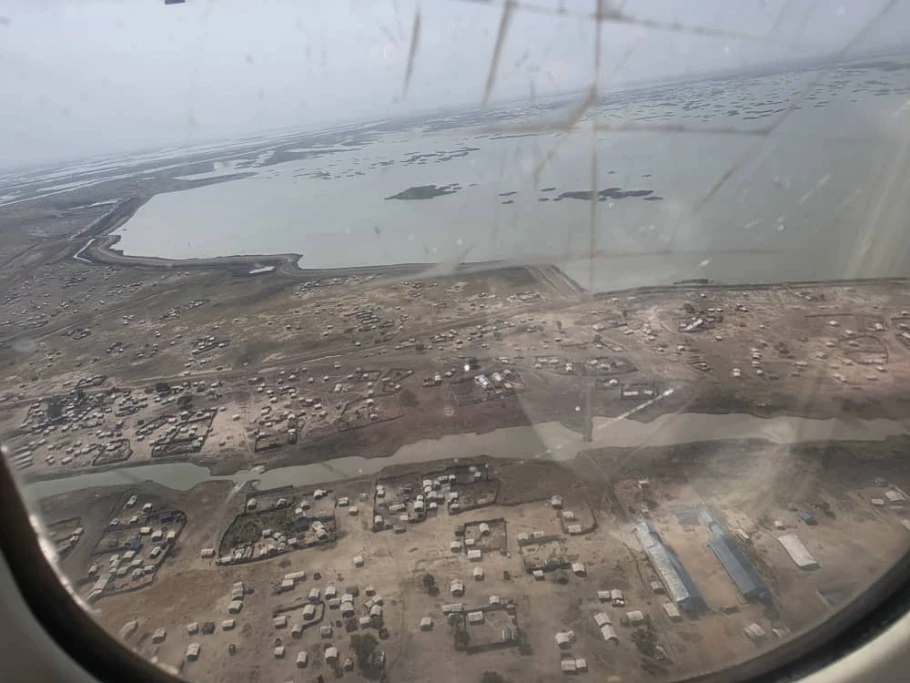
Nearly 109,000 displaced people living in Bentiu’s camp face renewed flood fears as persistently high water levels and the threat of El Niño-related heavy rains raise concerns about their safety, government and UN officials warned on Thursday.
The warning came during an ad hoc roundtable on durable
solutions for displaced people in Bentiu, following a joint government and UN
mission to the area in September.
Ramanathan Balakrishnan, the UN resident and humanitarian
coordinator, said persistent high water levels and the potential impact of a
strong El Niño event could bring severe flooding sooner than anticipated.
“What may have been considered a longer term contingency
must therefore be treated as an immediate preparedness priority,” Balakrishnan
said.
The International Organization for Migration (IOM) warned on
October 9 that 1.8 kilometers of dikes protecting Bentiu’s displacement camp
required urgent attention. Heavy rains could arrive before December, increasing
pressure on flood defences protecting displaced families and essential
infrastructure.
The wider network of dikes and embankments protects around
300,000 civilians, as well as critical infrastructure and supply routes,
according to the UN Mission in South Sudan.
The flood threat is compounded by funding shortages that
could disrupt essential services. IOM said funding for critical water,
sanitation and flood-protection operations in Bentiu and Malakal would run out
by the end of November without additional resources. The agency has appealed
for $8.35 million to maintain the services for 12 months, from December 2026 to
December 2027.
Dr. Kuyok Abol Kuyok, the minister of general education and
instruction, speaking on behalf of the humanitarian affairs minister, described
the health dangers facing people returning to flood-affected areas.
“My biggest concern there was the fact that when we were in
Bentiu, we saw how people were moving back to those places. And they were
drinking water from the stagnant water. The animals were drinking from the same
water. They were fishing from the same water,” Kuyok said, describing the
situation as a serious health concern.
He called for stronger partnerships and a shift from
repeated emergency responses towards preparedness, resilience and sustainable
recovery, as recurring floods damage homes, roads, farmland and other
infrastructure.
Balakrishnan said protecting communities required immediate
preparedness alongside longer-term investment in water management, essential
services and livelihoods. He also called for lasting solutions that give
displaced people safe opportunities to rebuild their lives.
“Communities must have meaningful choices and opportunities
to rebuild their lives,” he said.
The officials urged government institutions and humanitarian
partners to agree on responsibilities and sustain their efforts to protect
displaced families and develop durable solutions as flood risks grow.