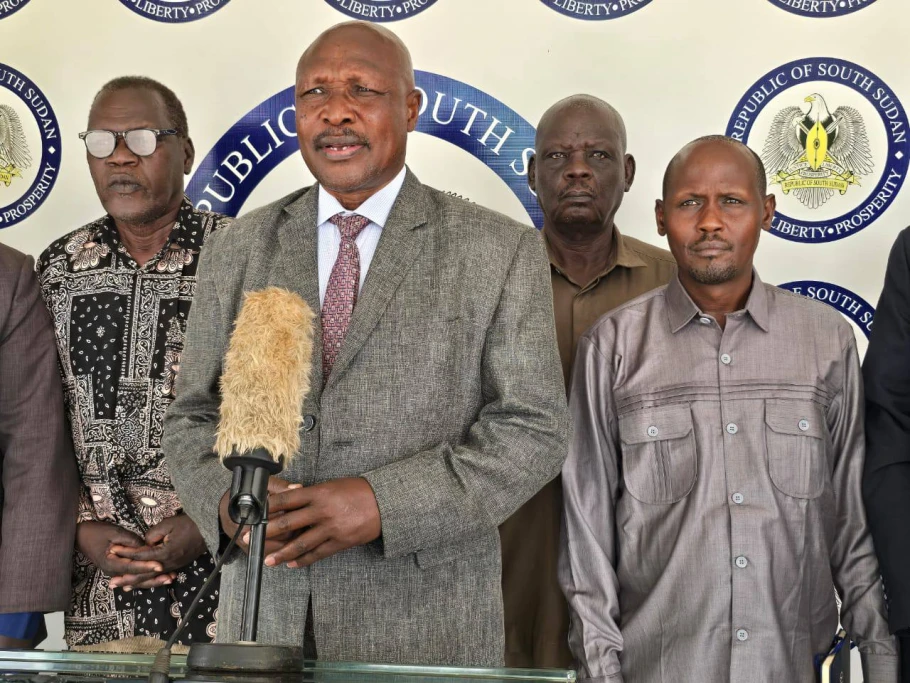
Eastern Equatoria State has protested its exclusion from the newly approved $2 billion national road construction projects, raising the issue in separate meetings with the Vice President in charge of the infrastructure cluster and the Minister of Roads and Bridges in Juba on Monday.
Governor Louis Lobong Lojore told the Vice President Taban
Deng Gai that the state’s major highways were left out of the Cabinet-approved
road projects.
“The people of Eastern Equatoria have received the news with
mixed feelings as to why Eastern Equatoria was not mentioned despite being
known as a minerals super house in the whole country. If gold is to be used for
roads, we believe it should involve our area,” Lojore said.
The delegation also met Minister Peter Lam Both to clarify
the government’s new policy framework for financing road construction, known as
the “Minerals for Roads” initiative, under which infrastructure projects are
implemented through mineral‑backed arrangements designed to accelerate
nationwide road development.
Julius Moilinga, speaking for the Eastern Equatoria
Parliamentary Caucus, said he welcomed the government’s infrastructure agenda
but expressed optimism that future phases of the programme would extend to all
regions, including Eastern Equatoria.
“Eastern Equatoria State […] will patiently await inclusion
in the next phase of road construction projects, which [he] described as
potentially transformative for the State and the country at large,” Molinga
stated.
In response VP Gai said the gold‑for‑roads initiative was a
pilot effort to assess the value of South Sudan’s mineral resources.
“I want to assure our people in Eastern Equatoria State that
no one will be left behind. This is a pilot phase to test the capability of the
company to deliver such investments. If it succeeds, we shall roll it out for
areas like Eastern Equatoria,” Gai said.
The Cabinet approved the project on Feb. 20, which will upgrade more than
1,031 kilometres of
strategic roads, including the Juba–Yei–Kaya, Yei–Faraksika–Maridi,
Juba–Lobonok–Moli
Junction, and Wau–Raja–Boro
Medina corridors.
Eastern Equatoria officials underlined the importance of
considering the state’s major highways in subsequent phases of the programme to
improve regional connectivity, support economic growth and enhance social
development.