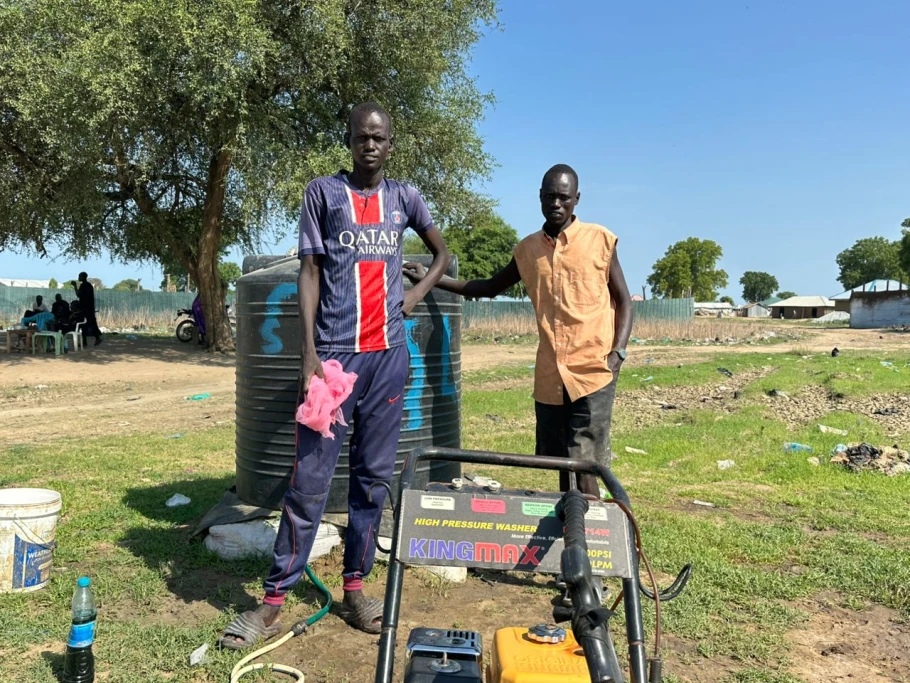
In Bor Town in Jonglei State, two young men from Tonj in Warrap State are rebuilding their lives through informal car and motorcycle washing, describing the work as a means of survival and self-reliance amid economic hardship.
Deng, one of the washers in Bor, said he moved after losing
most of his cattle through marriage, leaving him with little choice but to seek
work elsewhere.
“I had cows, but my marriage took them all, and there was
nothing left that is why I left Tonj,” Deng told The Radio Community (TRC) in
an interview on Thursday.
“I came to Bor looking for a job that can help. I have two
wives in the village with three children.”
He explained that the income, though unpredictable, supports
his family back home.
“Sometimes, when there are customers, I earn between 30,000
and 40,000 SSP daily. A car wash costs 70,000 SSP and a motorcycle wash 25,000
SSP,” he expressed.
He also linked his decision to avoid cattle-related conflict
to his choice of livelihood in Bor.
“What makes young people fight back home is when you take
somebody’s cattle. I don’t want to get involved in such bad activities,” he
asserted.
For Kach Yal, another worker, the job represents dignity in
honest labor.
“What is important is that if you are still strong and you
can earn a small amount of money, like 50 SSP in a day, it is not something
stolen,” Yal stated.
Yal noted that while similar work exists in Tonj, social
perceptions prevent many from doing it there.
“This kind of job exists in Tonj, Warrap State, but when you
are known as someone’s son, they sometimes consider you mad for doing such
work. Now, I can do this job here. I could not do car and motorcycle washing if
I were in Tonj,” he echoed.
With youth making up 72 percent of South Sudan’s population,
unemployment remains a major challenge.
Warrap State, the home region of President Salva Kiir, has
long experienced recurring violence. This includes cattle raiding, revenge
attacks, and intercommunal clashes, especially in Gogrial, Twic, and Tonj
counties.
Violence is often linked to cattle disputes. There are also
allegations that some political actors arm supporters, claiming it is to
protect livestock from raiders.
Cross-border cattle raids involving Mayom County in Unity
State have further increased tensions in the region. This has contributed to
continued insecurity.