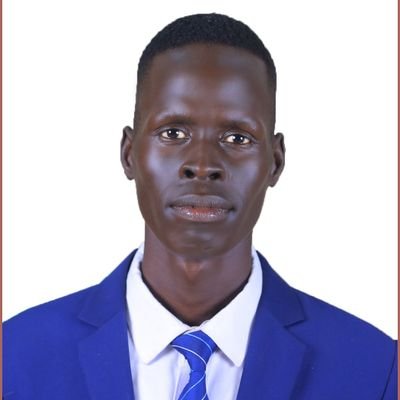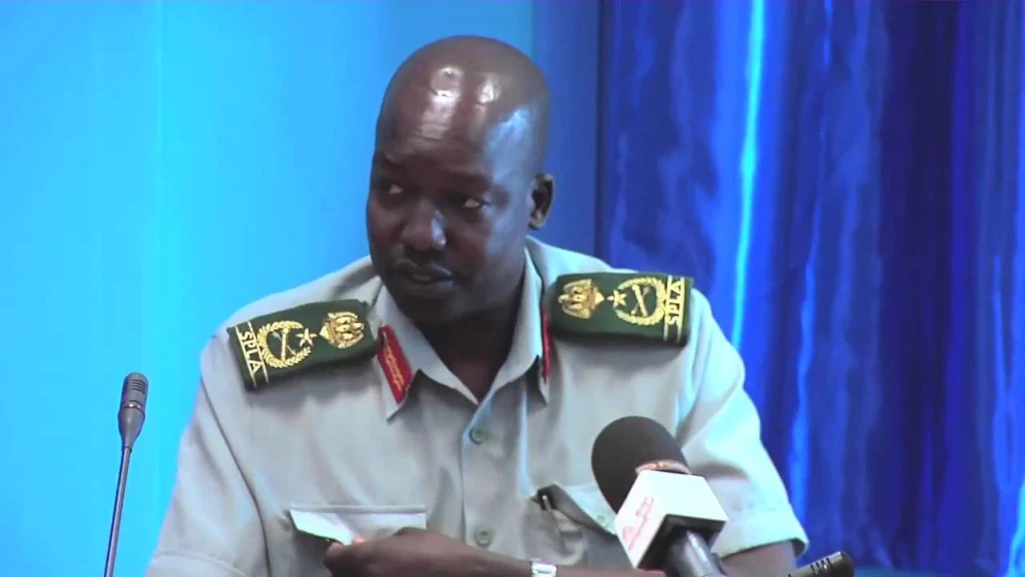
Gen. Thomas Cirilo Swaka, leader of the South Sudan
Opposition Movements Alliance and the National Salvation Front, has expressed a
willingness to engage in peace talks with the South Sudan government, despite
rejecting the Nairobi-based Tumaini Initiative led by Kenyan President William
Samoei Ruto.
In a two-day consultative meeting with IGAD Special Envoy
for South Sudan Ambassador Ismail Wais in Rome on Wednesday and Thursday, Gen.
Cirilo agreed to discuss it with the Kiir administration.
“SSOMA expressed its readiness to engage with the Government
of the Republic of South Sudan with a goal of achieving inclusive and
sustainable peace,” the IGAD statement reads.
Gen. Cirilo has been engaged in peace negotiations with the
South Sudanese government in the Rome peace talks since 2020 under the South
Sudan Opposition Movements Alliance (SSOMA).
These talks, facilitated by the Sant’Egidio Community, aimed
to find a resolution to the country's ongoing conflict.
The alliance of opposition groups involved in these
discussions included Cirilo's NAS, the National Democratic Movement-Patriotic
Front (NDM-PF) led by Emmanuel Ajawin, the South Sudan United Front/Army under
General Paul Malong, and the Real SPLM led by Pagan Amum.
However, after years of stalled progress, President Salva
Kiir shifted the talks to Nairobi in December 2023, requesting Kenyan President
Dr. William Samoei Ruto to take over as the new mediator. The negotiations were
rebranded as the Tumaini Initiative, meaning "hope" in Swahili.
When the talks were relocated, Cirilo, along with Emmanuel
Ajawin of NDM-PF, declined to participate, citing insecurity and unresolved
issues.
They parted ways with General Paul Malong of SSUFA/M and
General Pagan Amum of Real SPLM, who accepted President Kiir's shift of the
talks to Nairobi.
Malong and Pagan were joined by General Stephen Buay
Rolnyang, leader of the South Sudan People's Movement/Army (SSPM/A), and
General Mario Loku Thomas, leader of the breakaway faction National Salvation
Front's Revolutionary Command Council (NAS-RCC), in peace talks in Nairobi.
Gen. Cirilo's refusal to join the Tumaini Initiative has
sparked concerns among citizens and peace advocates, as it undermines
inclusivity in the peace process.
While the government continues negotiations with these
opposition groups who formed a new alliance—United People Alliance (UPA),
Cirilo’s absence raises fears that a fragmented approach could jeopardize
lasting peace in the country.
In a Thursday's meeting facilitated by the Community of
Sant’Egidio and attended by Kenyan Ambassador H.E. Fredrick Matwang’a, Cirilo
urged IGAD and Sant’Egidio to start the process in Rome as soon as possible.
“SSOMA agreed that IGAD and the Community of Sant’Egidio
facilitate a pre-consultative meeting with the Government of the Republic of
South Sudan at the earliest opportunity,” the statement added.
Church leaders are also reaching out to armed groups to join
the peace process in South Sudan, emphasizing the need for lasting peace.
South Sudan, the world’s youngest nation, plunged into
conflict in 2013, just two years after gaining independence from Sudan on July
9, 2011.
The country has since been plagued by fractured rebellions
and ethnic and communal violence, which have hindered peace efforts and stalled
economic and infrastructural development.
The country’s stability is once again at risk, with tensions
escalating in the Upper Nile region between the UPDF-backed government forces
(SSPDF) and the White Army, allied with First Vice President Dr. Riek Machar’s
SPLM-IO.
The ongoing conflict has resulted in civilian casualties and
displacement, raising concerns over the collapse of the 2018 peace agreement
that ended a five-year civil war between President Kiir and Dr. Machar.
There are fears that without de-escalation and dialogue, South Sudan could slip back into full-scale civil war. Fourteen years after independence, the country is still struggling to stabilize, with national elections now scheduled for December 2026.