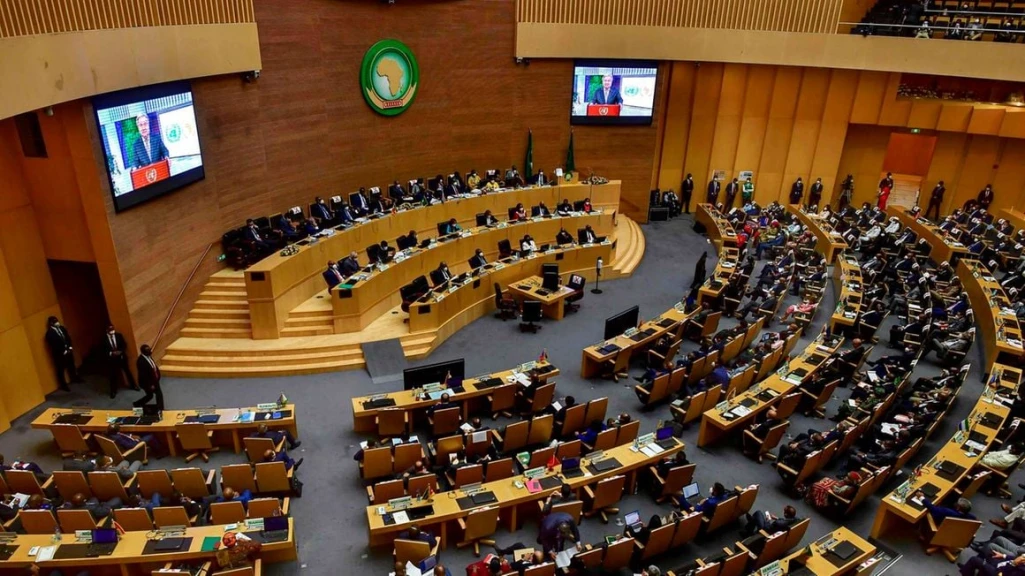
An African Union session at its headquarters in Addis Ababa, Ethiopia | Credit | Tony Karumba/AFP
The African Union Peace and Security Council (AU PSC) is expected to visit Juba, South Sudan, later this week for high-level consultations on the country’s peace process and preparations for the December 2026 elections.
According to the AU Mission in South Sudan, the delegation
will be in the country from April 23 to 25, 2026, as part of a field mission to
assess progress on the implementation of the 2018 Revitalized Peace Agreement.
During the visit, the AU PSC is scheduled to meet President
Salva Kiir, alongside the Vice Presidency and key stakeholders,
including institutions established under the peace agreement, the United
Nations Mission in South Sudan (UNMISS), the Intergovernmental Authority on
Development (IGAD), and the Reconstituted Joint Monitoring and Evaluation
Commission (RJMEC).
The council will also engage civil society and other actors
to gather first-hand information on the status of transitional arrangements
ahead of the planned elections.
The AU said the mission will inform its decisions on “the
next steps required to effectively support the Government and people of South
Sudan to successfully complete the outstanding transition.”
Civil society groups have welcomed the visit but urged the
AU PSC to ensure it produces concrete outcomes, including progress on political
detainees, adherence to the ceasefire, and inclusive dialogue among signatory
parties.
Edmund Yakani, Executive Director of the Community
Empowerment for Progress Organization (CEPO), said repeated AU visits show
solidarity but must lead to tangible action.
“We hope that this visit will yield tangible results around
the release of the political detainees in Juba and across the country. Among
them is the first vice president, Dr. Riek Machar, who is suspended and
undergoing trial with some of his party co-accused,” Yakani said.
He cited concerns over declining political trust, delayed
implementation of the peace agreement, and continued tensions among key
parties.
First Vice President and SPLM/A-IO leader Riek Machar is
currently under house arrest while facing trial alongside seven co-accused over
the Nasir incident of March 2025.
Prosecutors allege that coordinated attacks involving
SPLA-IO elements and allied White Army forces led to the deaths of 257 SSPDF
personnel and the destruction of military equipment valued at about USD 58
million during an assault on the Nasir garrison.
The accused face charges including murder, conspiracy,
terrorism, treason, destruction of public property and crimes against humanity.
The co-accused remain in National Security Service detention facilities in
Juba.
The case has heightened tensions between SPLM/A-IO forces
and the SSPDF, while international calls for Machar’s release have been
rejected by the government, which maintains that the judicial process must
proceed independently.
On February 20, 2026, the C-5 called for an immediate
ceasefire, full implementation of the peace agreement, inclusive dialogue
without preconditions, preparation for the December 2026 elections, release of
political detainees, and coordination of international support to secure
lasting peace.
The African Union in March appointed former Tanzanian
President Jakaya Kikwete as special envoy for South Sudan under the AU Ad Hoc
High-Level Committee on South Sudan (C-5), a mechanism supporting
implementation of the 2018 agreement. He visited Juba two weeks ago, but
tangible outcomes remain limited as the AU PSC prepares to reinforce efforts.
South Sudan remains in a fragile transition following the
2013 conflict, with repeated delays in implementing key provisions of the peace
deal, including security arrangements, institutional reforms, and electoral
preparations.
The country’s first general elections, now scheduled for December 2026, have been postponed several times amid ongoing political and security challenges.