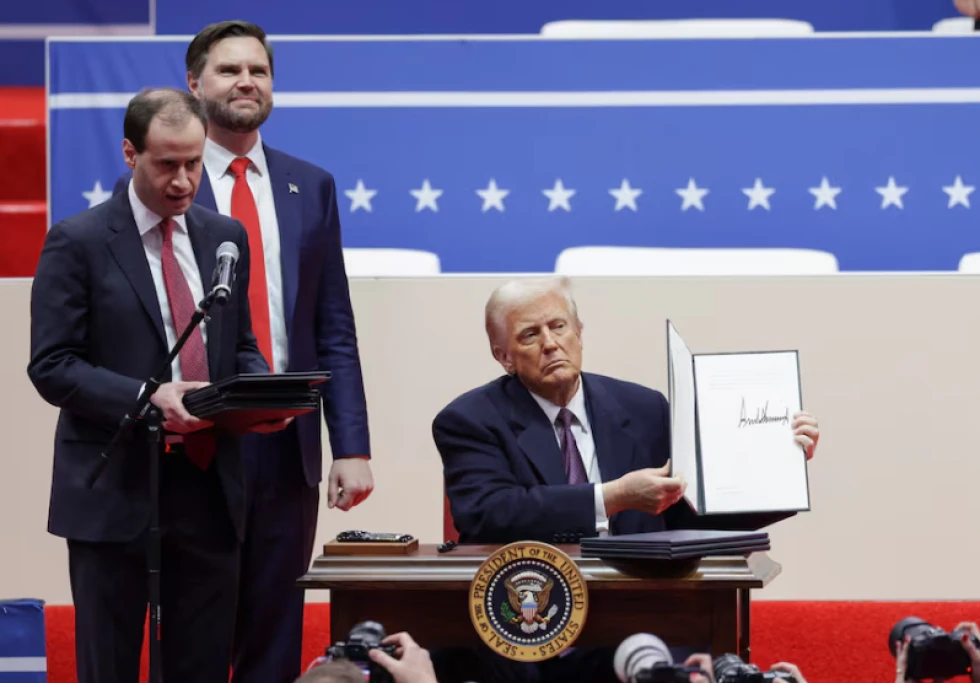
Donald Trump pardoned
about 1,500 of his supporters who attacked the U.S. Capitol four years ago as
he moved swiftly to impose his will on the U.S. government just hours after
reclaiming the presidency on Monday.
After a day
of ceremony, Trump signed a series of executive actions to curb immigration and
roll back environmental regulations and racial and gender diversity
initiatives. He did not take immediate action to raise tariffs, a key campaign
promise, but said he could impose 25% duties on Canada and Mexico on Feb. 1.
His decision
to pardon
supporters who attacked the U.S. Capitol on Jan. 6, 2021, is sure to
enrage police, lawmakers and others whose lives were put at risk during an
unprecedented episode in modern U.S. history.
Roughly 140
police officers were assaulted during the attack, with some sprayed with
chemical irritants and others struck with pipes, poles and other weapons. Four
people died during the chaos, including a Trump supporter who was shot dead by
police.
Trump ordered
14 leaders of the far-right Oath Keepers and Proud Boys militant groups, who
were serving long prison sentences, released from prison early, but left their
convictions intact.
Earlier in
the day, Trump, 78, took the oath of office in the Capitol Rotunda, where a mob
of his supporters had rampaged on Jan. 6 in an unsuccessful attempt to reverse
his 2020 loss to Joe Biden.
At the
ceremony, Trump portrayed himself as a savior chosen by God to rescue a
faltering nation. His inauguration amounts
to a triumphant return for a political disruptor who survived two assassination
attempts and won election despite a criminal conviction and a prosecution
stemming from his efforts to overturn his 2020 election loss.
"I was
saved by God to make America great again," he said.
Trump is the
first president in more than a century to win a second term after losing the
White House and the first
felon to occupy the White House. The oldest president ever to be sworn
in, he is backed by Republican majorities in both chambers of Congress.
Trump moved
quickly to clamp down on illegal immigration, a signature issue since he first
entered politics in 2015.
Shortly after
he took the oath of office, U.S. border authorities shut down a program that
allowed hundreds of thousands of migrants to enter the U.S. legally by
scheduling an appointment through a smartphone. Existing appointments were
canceled.
Nearly
1,660 Afghans who had been cleared by the U.S. government to resettle
in the U.S., including family members of active-duty U.S. military personnel,
were having their flights canceled under a Trump order suspending U.S. refugee
programs, a U.S. official and a leading refugee resettlement advocate said on
Monday.
Border
emergency declared, climate deal nixed
At the White
House, Trump signed an order that declared a national emergency at the
U.S.-Mexico border, which would unlock funding and allow him to dispatch troops
there. He signed an order that would end a policy that confers citizenship to
those born in the United States, which is certain to trigger a lengthy court
fight. Another executive order designated Mexican
drug cartels as terrorist organizations.
Trump once
again withdrew
the United States from the Paris climate deal, removing the world's
biggest historic emitter from global efforts to fight climate change for the
second time in a decade.
"We're
getting rid of all the cancer ... caused by the Biden administration,"
Trump said as he signed a stack of executive orders in the Oval Office.
Other orders
revoked Biden administration policies governing artificial intelligence and
electric vehicles. He also imposed a freeze on federal hiring and ordered
government workers to return to the office, rather than working from home. He
also signed paperwork to create a "Department of Government
Efficiency," an outside advisory board headed by billionaire Elon Musk
that aims to cut large swaths of government spending.
In the State
Department, more than a dozen
nonpartisan senior diplomats were asked to resign as part of a broader
plan to replace nonpartisan civil servants with loyalists.
He also said
he would issue orders to scrap federal diversity programs and require the
government to recognize only genders assigned at birth.
While Trump
sought to portray himself as a peacemaker and unifier during his half-hour
speech, his tone was often sharply partisan. He repeated false claims from his
campaign that other countries were emptying their prisons into America and
voiced familiar grievances over his criminal prosecutions.
With Biden
seated nearby, Trump issued a stinging indictment of his predecessor's policies
from immigration to foreign affairs.
"We have
a government that has given unlimited funding to the defense of foreign
borders, but refuses to defend American borders, or more importantly, its own
people," Trump said.
Numerous tech
executives who have sought to curry favor with the incoming administration -
including the three richest men in the world, Tesla and SpaceX CEO Elon Musk,
Amazon founder Jeff Bezos and Meta CEO Mark Zuckerberg - had prominent seats on
stage, next to cabinet nominees and members of Trump's family.
Trump said he
would send astronauts to Mars, prompting Musk - who has long talked about
colonizing the planet - to raise his fists.
Trump vowed
to change the name of the Gulf of Mexico to the Gulf of America and repeated
his intention to take back control of the Panama Canal, one of several foreign
policy pronouncements that have caused
consternation among U.S. allies.
Return to
power
Trump took
the oath of office to "preserve, protect and defend" the U.S.
Constitution at 12:01 p.m. ET (1701 GMT), administered by Chief Justice John
Roberts. His vice president, JD Vance, was sworn in just before him.
Outgoing Vice
President Kamala Harris, who lost to Trump in November, was seated next to
Biden in a section with former Presidents Barack Obama, George W. Bush and Bill
Clinton. Former Secretary of State Hillary Clinton, who lost to Trump in 2016,
sat with her husband Bill. Obama's wife, Michelle, chose not to attend.
The ceremony
was moved indoors due to the extreme cold gripping much of the country.
Trump skipped
Biden's inauguration and has continued to claim falsely that the 2020 election
he lost to Biden was rigged.
Biden, in one
of his last official acts, pardoned several
people whom Trump has threatened with retaliation, including General Mark
Milley, a former chairman of the Joint Chiefs of Staff who Trump has suggested
should be executed for holding back-channel talks with China. Milley's portrait
was removed from the Pentagon shortly after Trump's inauguration.
He also
pardoned five family members minutes before leaving office, citing fears that
Trump would target them.