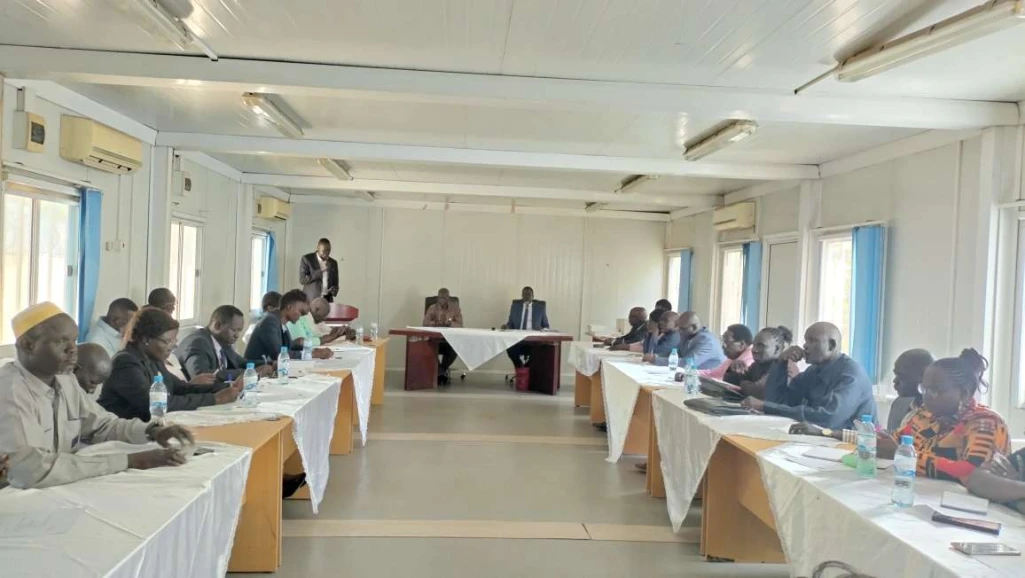
Some members of the National Constitutional Review during the first orientation meeting on December 22, 2023. |Credit |Daniel Garang Deng/TRC
Fourteen years after independence, South Sudan remains without a permanent constitution, an absence many citizens believe has fueled instability, underdevelopment, and poor governance.
Despite repeated promises, the constitution-making process
remains stalled, mired in economic challenges, political divisions, mistrust, and a lack of
political will. The delay continues to frustrate citizens across the country.
John Lokuda, a youth from Kapoeta South County of Eastern Equatoria State, said the absence of
a constitution has deepened conflict and division.
"Post-independence, we have gone through a lot of
conflict. I believe that if the constitution had been in place and if it had
not been delayed, we would not be facing some of these issues,” Lokuda said.
Hellen Siama, Deputy Chairlady of the Toposa Women
Association, echoed, "The current situation of South Sudan itself is a
result of delayed permanent constitution. We are really urging the government
and the commission to speed up the constitution making so that we can go for
our election and put things in place."
This frustration is shared across marginalized groups. Physically
impaired Malisha Nyabon, an auto mechanic and Chairperson of persons with
disabilities in Awerial County of Lakes State, lamented their exclusion.
"We, the people with disabilities, we are always
discriminated and neglected in every decision-making meeting. South Sudanese
are fighting for power, and we don’t understand anything because we are far
from those discussions,” Nyabon stated.
From Bor to Abyei, citizens say promises are no longer
enough, especially with general elections approaching that require a
constitution to be in place first.
"When there is no permanent constitution, the elections
will not happen because there are no laws that will guide the government in the
process," warned Mary Ajier Malony in Bor, Jonglei State.
Achai Ngor, a member of the Abyei Women Association, sees
the process as a chance to unite the country.
"Is there any good thing as beautiful as South Sudanese
sitting down together to produce our own constitution to govern ourselves as a
country? All this tribalism will go away, and we will be one people,” Ms. Ngor argued.
A broken process
After independence in 2011, the transitional constitution
was supposed to last three years. The National Constitutional Review Commission
(NCRC) was formed in 2012, but civil war in 2013 disrupted progress.
Peace agreements in 2015 and 2018 reignited efforts, leading
to the enactment of the Constitution-Making Process Act in 2022. The NCRC was
reconstituted in late 2023 and began work in 2024.
Yet by 2025, a permanent constitution is still far from
being achieved.
John Natana Abraham, the NCRC Secretary-General, said the
team is prepared to engage citizens but lacks funds.
"The main thing facing us now is the issue of funding,
because for our members to go all over the country, they need funding in order
to do the work," Natana explained.
Of the $43 million budget, the constitution-making body
received only $800,000, which it used to furnish offices and train staff.
Hon. Michael Ayuen, Chair of Parliament’s Finance Committee,
said the government is committed to a people-centered constitution but blamed
the delay on economic challenges.
"We will make sure that when the budget comes, we will
do our part and hopefully funds will be released, and the constitution shall be
written by you, the people of South Sudan," Ayuen said.
The MP said parliament has yet to question the Finance
Minister on last year’s budget implementation, which included peace and
election preparations, and while it pledges to prioritize the process in the next
budget, funding is only part of the puzzle.
Politics behind the delay
At the heart of the delay is a political tug-of-war between
the ruling Sudan People Liberation Movement in government (SPLM-IG) and the Sudan
People Liberation Movement in opposition (SPLM-IO).
Even before the process restarted in 2024, the government
(SPLM-IG) stated its position that elections can proceed without a permanent constitution. SPLM-IO has also maintained its stance that a permanent
constitution must come first, as outlined in the 2018 peace agreement.
Professor (Associate) Abraham Kuol Nyuon, a political analyst at the University of Juba, said the process is affected by underlying political mistrust, which is further complicated by the NCRC leadership headed by the representative of the SPLM-IO.
"The fact that the constitution making process is led
by a representative of SPLM-IO. That might be problematic to the SPLM-IG, and
they might think that he might manipulate the system," Kuol said.
He also noted that the coalition government includes many
competing interests, SPLM-IG, SPLM-IO, SSOA, OPP, and Former Detainees pulling
in different directions.
Kuol argued that reluctance to finalize the constitution may
be a tactic by the ruling elite to maintain power and avoid accountability.
“The government is reluctant because making a permanent
constitution means empowering the people of South Sudan and when you empower
people, it means the current status quo will be removed,” Kuol argued.
“The current status quo is that there are people above the
law and making a constitution which gives rights to the citizens to demand
whatever they wish to be done, means putting the law above everybody and making
everybody accountable.”
When contacted for a response, Michael Makuei, Minister of
Information and government spokesperson, declined to comment, saying, "I’m
not ready for all these now."
"The ball is in President Kiir’s court"
For Kuol and others, the burden of leadership to deliver constitution
now rests with President Salva Kiir.
"President Kiir as the head of the coalition
government, has to make a decision whether to be the president for politicians
or the president for the people of South Sudan," Kuol said.
“The
president needs to make some legacy; he needs to play some sort of
dictatorship. He needs to arrest some people, and he needs to put the
condition.
“This
country is taken hostage by ministers, generals, children of the liberators and
I think the president needs to do something about this because when you
liberate people, you don't liberate people halfway. You liberate people once
and for all.”
Civil society sounds the alarm
Civil society leaders warn that if the process is rushed or
manipulated for political gain, it may lose its legitimacy and become another political
show.
"The process needs to be people-driven. However, if a
mistake is made that few people sit to draft this constitution, it is a waste
of resources and time," said Lorna Merekaje Nanjia, Secretary-General of
the South Sudan Democratic Engagement Monitoring and Observation Programme.
Each year of delay adds to South Sudan’s fragility. Without
a permanent constitution, the country faces deepening divisions, lawlessness,
and loss of public trust.
"If the constitution making is going to be delayed,
there are those who will take advantage and use unconstitutional means to take
power from the seating government," warned John Lokuda.
Many now see the constitution not as a legal formality, but
as a necessary foundation for peace, justice, and nation-building.
South Sudan is scheduled to hold its first general elections
in December 2026 but without a permanent constitution, many doubt the elections
will happen or be credible.