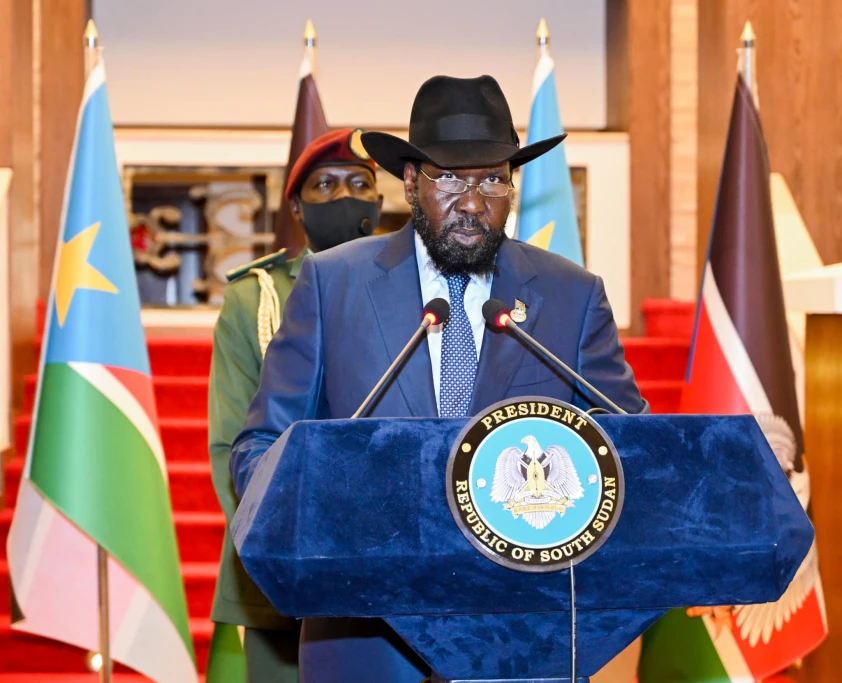
President Salva Kiir addressing the nation on the 11th anniversary of the Independence Day – July 9, 2022.
Credit//Office of the PresidentAs South Sudan prepares to celebrate its14th Independence Anniversary on July 9, people have high expectations for President Salva Kiir’s national address on key pressing issues.
In a statement welcoming President Kiir back from a
10-day official visit to the United Arab Emirates, Civil society and Executive
Director of the Community Empowerment for Progress Organization (CEPO) Edmund
Yakani, shared his expectations for president speech on July 9.
Yakani specifically asked the President to talk about
the reopening South Sudan’s national Parliament, which has been on break for
more than six months.
"The Parliament is having a heavy task in
relation to bills before them and in relation to their oversight role in
checking the executive in delivering their performance as per their individual
ministerial mandates,” Yakani pointed out.
Among the bills that Yakani expects to see prioritized
include the Rights of Persons with Disabilities Bill, Gender-Based Violence
Bill and the Family Law Bill.
He also ask for reaffirmation of the government’s commitment to protecting children from armed conflict, particularly as part of the Action Plan for the Protection of Children Associated with Armed Forces.
Yakani also stressed the urgent need for the President to talk about the country’s preparations for the polls.
“Things associated with timely release of the
electoral calendar, adequate and timely funding of the National Election
Commission and political decisions on challenges in translation of the amended
National Election Act 2023 and matters of constitutional making process and
population census that are linked to the elections,” Yakani said.
“The recently reconstituted high-level ad hoc
committee on the implementation of the pending task of our R-ARCSS should hold
an inclusive dialogue that bring in parties signatory to our R-ARCSS and
stakeholders to have a deliberation on genuine basis on how we should conduct
the elections.”
The Revitalized Agreement, which ended the five-year
conflict in South Sudan, outlines important reforms and provisions to
transition the country into the democratic dispensation.
However, it has faced continual setbacks, resulting in
several delays of general elections, now set for December 2026. Despite this,
the deal still encounters major challenges, especially after the recent arrest
of First Vice President Dr. Riek Machar, a key partner in the R-ARCSS.
The detention of Dr. Machar, a key signatory to the peace
deal, has raised concerns among regional and international observers about the
integrity of the peace process.
With national elections scheduled for later 2026, there are concerns over the readiness of institutions, the absence of unified security forces, and constitution and electoral reforms. These are all key benchmarks specified in the R-ARCSS.