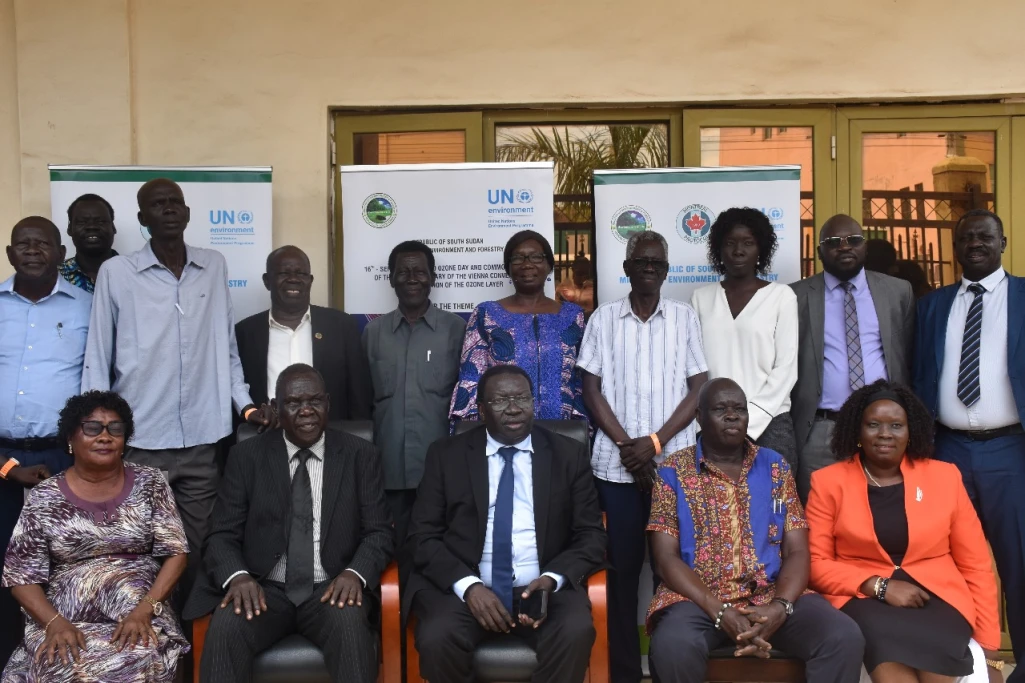
The Ministry of Environment and Forestry has called on South
Sudan to urgently ratify the Kigali Amendment to the Montreal Protocol, warning
that delays could cost the country major international funding for protecting
the ozone layer.
David Batali, Director General for Sustainable Development
in the Ministry of Environment and Forestry, emphasized South Sudan’s
commitment to global environmental efforts during the World Ozone Day
commemoration on Tuesday.
“South Sudan acceded to the Montreal Protocol in 2012. So,
the principles aim of the Montreal Protocol is to protect the ozone layer by
taking measures to control total global production and consumption of the
substances that deplete the ozone layer, with the ultimate objective of
eliminating these substances on the basis of developments in scientific
knowledge and technological information,” Batali said.
He also praised the success of the Montreal Protocol and
highlighted South Sudan’s ongoing steps toward the Kigali Amendment.
“Among the UN conventions, the Montreal Protocol is the most
successful protocol that has been implemented globally. Everything has been
moving smoothly. That is why there are so many amendments. The last one is the
Kigali Amendment which South Sudan is now in the process of accepting to it,”
he added
The Undersecretary for Environment and Forestry Joesph
Africano Batali also expressed concern over the slow ratification process,
citing bureaucratic turnover as a key challenge.
“We are yet to ratify the Kigali and we are frustrated
because there is a lot of turnover in the ministry. We submit to the Ministry
of Foreign Affairs, they review, then a new person comes in and changes the
whole post referring to the Ministry of Justice,” Africano said.
He noted that South Sudan has already acceded to the
Montreal Protocol and is moving to ratify the amendment to secure funding for
key environmental activities.
“We have already acceded to the Montreal Protocol so there
is no need for us again to take the whole thing to parliament so if there is an
amendment we review, if it doesn't have any contradiction with our laws, that
we simply ratify. I think very soon we will try to make sure that it is
ratified because if we don't ratify, there is a lot of funding that is supposed
to come to the country for us to be able to implement other activities,” he
mentioned.
The officials emphasized the importance of public awareness
and international cooperation to protect the ozone layer, noting that delays
could hinder the country’s ability to participate fully in global environmental
initiatives.
The Montreal Protocol, adopted in 1987, is an international environmental agreement that aims to phase out the production and consumption of ozone-depleting substances such as chlorofluorocarbons (CFCs). The Kigali Amendment, adopted in 2016, builds on the protocol by targeting hydrofluorocarbons (HFCs), which, while not depleting the ozone layer, contribute significantly to global warming.